




Engineering-Grade 304/430 Stainless Steel Plates for Factory Platforms and Walkways
Engineering-Grade 304/430 Stainless Steel Plates for Factory Platforms and Walkways
Industrial platforms, walkways, maintenance stations and production-floor covers must resist repeated foot traffic, tool movement, oil contamination, cleaning cycles and changing humidity without creating excessive maintenance work. Cold-rolled stainless steel sheet offers a stable, fabrication-friendly base material for these applications, while hot-dip galvanized sheet provides an economical corrosion-protected alternative for suitable environments. This guide explains how to match grade, thickness, size and finish to practical factory conditions, and it identifies the engineering controls required before a flat sheet is used as part of a walking-working surface.
1. Product Range and Standard Engineering Options
The product range covers 304, 316 and 430 stainless steel, plus hot-dip galvanized steel sheet. Standard thicknesses are 0.90 mm for light-duty cladding, decorative facing and supported secondary components, and 2 mm for more demanding covers, platform skins and fabricated assemblies. Standard sheet dimensions of 2500 × 1250 mm and 3000 × 1250 mm support batch cutting, nesting and repeatable fabrication.
| Material | Typical Positioning | Recommended Evaluation |
|---|---|---|
| 304 stainless steel | General industrial use, humid interiors, frequently cleaned areas and mixed indoor-outdoor service | Corrosion exposure, cleaning chemicals, load support and fabrication method |
| 316 stainless steel | Chloride-bearing, coastal, chemical or more aggressive environments | Chloride level, temperature, crevices, drainage and lifecycle cost |
| 430 stainless steel | Cost-sensitive, non-aggressive indoor engineering and decorative applications | Humidity, contamination, weld requirements and local corrosion risk |
| Hot-dip galvanized sheet | Budget-focused industrial structures where zinc coating is suitable | Coating thickness, cut-edge treatment, abrasion and atmospheric category |
For procurement and quality control, buyers should specify the applicable material standard, grade, thickness tolerance, surface finish, flatness, edge condition and required test documentation. ASTM A240/A240M covers chromium and chromium-nickel stainless steel plate, sheet and strip for general applications, including building and construction uses. This gives engineering teams a recognized reference point for chemical composition and mechanical-property requirements rather than relying only on commercial grade names.
2. Choosing Between 304, 316, 430 and Galvanized Steel
304: the general-purpose industrial baseline
Type 304 is widely used where a combination of corrosion resistance, formability and weldability is required. It is a practical baseline for factory platforms, machine-side service decks, access covers, production-area panels and maintenance structures exposed to normal atmospheric moisture and routine washing. Its passive chromium-rich surface helps resist ordinary oxidation, but selection must still consider chlorides, acidic residues, stagnant moisture and cross-contamination from carbon-steel tools.
316: additional protection for harsher exposure
Where salt, chloride-bearing wash water, coastal air or more aggressive process contamination is present, 316 should be evaluated rather than assuming 304 is sufficient. The worldstainless corrosion-resistance guidance explains that pitting risk rises with factors such as chloride concentration and temperature, and that grade selection must be based on the actual exposure. This is particularly relevant for plants in coastal regions, fertilizer handling, chemical processing, food production and frequently washed facilities.
430: economical for controlled environments
Type 430 is a ferritic stainless steel that can offer a useful balance of appearance, moderate corrosion resistance and cost in non-aggressive indoor conditions. It is often considered for stair trims, decorative tread facings, machine guards, wall protection and lightly loaded inspection-platform components. Because its fabrication and corrosion behavior differ from austenitic 304 and 316, the final design should account for forming radius, welding method, heat tint and the specific service environment.
Hot-dip galvanized sheet: zinc-based corrosion protection
Galvanized sheet remains a practical alternative for many industrial support structures, covers and enclosures. The American Galvanizers Association describes hot-dip galvanizing as providing barrier protection, cathodic protection and zinc-patina protection. In real projects, designers should also consider abrasion, cut edges, welded zones, chemical exposure and whether the coating will be damaged during fabrication or service.
3. Thickness Selection: 0.90 mm Versus 2 mm
Thickness should never be selected by appearance alone. A 0.90 mm sheet may be appropriate for supported liners, decorative faces, machine enclosures, wall guards and light-duty fabricated parts. It is not automatically suitable as a self-supporting walkway surface. A 2 mm sheet provides greater local stiffness and impact tolerance, but its safe load capacity still depends on span, support spacing, fixing method, edge restraint, perforation or embossing geometry, concentrated loads and fatigue exposure.
For platform and walkway work, the structural engineer should define:
- uniform and concentrated design loads;
- support spacing and deflection limits;
- fastener or weld layout;
- edge reinforcement and openings;
- vibration and fatigue conditions;
- drainage, cleaning and anti-slip requirements;
- corrosion allowance or grade upgrade where necessary.
This distinction is essential because “2 mm stainless steel” is a material description, not a complete structural rating. Load tables or project calculations should be based on the finished panel geometry and support system.
4. Surface Finishes: 2B, Satin and BA
Surface finish affects appearance, cleanability, glare, scratch visibility and downstream fabrication. The worldstainless guide to stainless-steel surface finishes describes finishes ranging from matte and brushed surfaces to highly reflective mirror-like surfaces.
- 2B industrial finish: a common smooth cold-rolled finish suitable for general engineering, fabrication and areas where a practical, low-profile appearance is preferred.
- Satin or brushed finish: provides a directional texture that can reduce the visual impact of minor handling marks and support a more architectural appearance.
- BA bright finish: offers high reflectivity and a smooth appearance for decorative, clean or visually prominent components, but may show fingerprints, scratches and glare more readily.
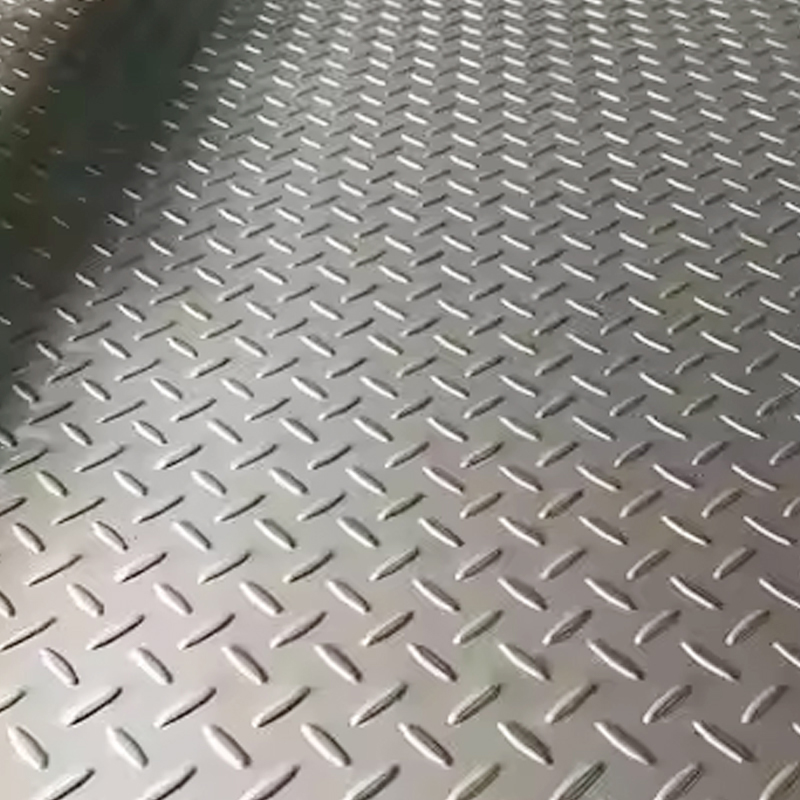
For heavily trafficked factory floors, a polished or smooth finish should not be treated as an anti-slip solution. Where people walk on the finished assembly, specify a tested anti-slip pattern, perforated or serrated geometry, embossed surface, grating, coating or other engineered treatment appropriate to contamination and footwear conditions.
5. Safety Requirements for Factory Walkways and Platforms
Industrial walking surfaces must be designed as safety systems, not simply as sheet-metal products. OSHA 29 CFR 1910.22 requires walking-working surfaces to be maintained in a clean, orderly and, to the extent feasible, dry condition, and it addresses drainage and dry standing places where wet processes are used. Although local rules vary by country, the engineering principle is universal: material corrosion resistance does not replace load verification, slip control, drainage, housekeeping, edge protection or inspection.
For oily workshops, machine halls and maintenance corridors, a robust specification may include:
- anti-slip perforation, raised pattern or serrated tread geometry;
- drainage openings positioned away from critical support lines;
- sealed or hygienic joints where contamination control is important;
- contrasting stair nosings and clearly defined level changes;
- removable access panels with secured fasteners;
- documented load capacity and periodic inspection intervals.
6. Fabrication, Installation and Quality Control
Cold-rolled stainless sheet is compatible with cutting, bending, punching, perforating and welding when the correct tooling and procedures are used. Fabricators should avoid carbon-steel contamination by separating tools or thoroughly cleaning shared equipment. Cut edges should be deburred, heat tint should be removed where corrosion performance matters, and stainless-compatible consumables should be selected for welded assemblies.
Recommended purchasing and inspection checkpoints include:
- mill test certificate and grade verification;
- measured thickness and dimensional tolerance;
- flatness and surface-defect inspection;
- protective-film condition where specified;
- finish direction for satin or brushed panels;
- sample bend, weld or perforation trial for repeat production;
- packing method suitable for export and site handling.
Standardized 2500 × 1250 mm and 3000 × 1250 mm formats can improve nesting efficiency, but actual cutting loss depends on part geometry, kerf, edge allowance, finish direction and order mix. A project-specific cutting plan should therefore be prepared before promising a fixed scrap percentage.
7. Solving Common Industrial Flooring and Platform Problems
Problem: carbon-steel rust and repeated repainting
Unprotected or damaged carbon steel may require recurring surface preparation and recoating. Stainless steel can reduce dependence on painted corrosion barriers in suitable environments, while galvanized steel can provide a durable zinc-based protection system. The correct choice depends on exposure, abrasion and repair access.
Problem: thin sheet deformation and unstable equipment support
Increasing sheet thickness may help, but the decisive factors are support spacing, stiffeners, formed ribs, edge returns and connection design. A flat 2 mm sheet with an excessive unsupported span may still deflect. Engineering calculations or tested load tables should control the final selection.
Problem: oil, dust and difficult cleaning
Smooth stainless surfaces are generally easy to wipe, but oily walking areas also need drainage, cleaning procedures and slip control. Finish selection should balance cleanability with traction and scratch visibility.
Problem: high cutting waste and inconsistent non-standard sizes
Standard sheet formats, repeatable drawings and nesting software can reduce waste and simplify procurement. However, finish direction, edge quality and perforation patterns must be included in the nesting plan.
Problem: choosing the cheapest grade without lifecycle analysis
A low initial price can be offset by repainting, shutdowns, cleaning difficulty, premature replacement or corrosion-related safety risks. Compare installed cost, maintenance access, expected contamination and service life rather than sheet price alone.
8. Supplier-Reported Machinery-Plant Upgrade Case
In a supplier-reported upgrade at a large machinery manufacturing plant in eastern China, the facility operated continuously with frequent pedestrian traffic, tool dragging and oil contamination. The main production-floor covers, maintenance platform and primary access routes were specified in 2 mm 304 stainless steel with a 2B finish. Secondary stair-facing components and small inspection stations used 0.90 mm 430 brushed sheet where exposure and structural demand were lower.
According to the supplied project information, the installation remained free from visible rust and major deformation after 24 months, and routine oil contamination could be removed with straightforward cleaning. The supplier reported a reduction of more than 40% in annual platform-maintenance labor and material cost compared with the previous carbon-steel arrangement. These results should be treated as project-specific rather than universal; buyers should verify loading, support design, environment, cleaning chemicals and maintenance records for their own application.
9. Target Regions and Buyer Profiles
The standardized sizes and material options are relevant to new-build and refurbishment projects in the Middle East and Africa, including Saudi Arabia, the United Arab Emirates, Iraq, Yemen, Egypt, Nigeria and Kenya. Grade selection should not be based on region alone. Coastal chloride exposure, desert dust, condensation, washdown chemistry, temperature and maintenance capability can vary significantly within the same country.
Typical buyers and decision-makers include factory engineering departments, EPC contractors, industrial flooring contractors, steel service centers, machinery manufacturers, warehouse operators, maintenance managers, procurement teams, food-processing plants, logistics facilities, utilities and infrastructure subcontractors.
10. Practical Specification Checklist
- Define whether the sheet is decorative, protective, load-bearing or part of a tested flooring system.
- Confirm environment: indoor, outdoor, coastal, chloride-bearing, chemically contaminated or frequently washed.
- Select grade: 430 for controlled non-aggressive use, 304 for broad general service, 316 for increased corrosion demand, or galvanized steel where zinc protection fits the application.
- Set thickness and support spacing through calculation or tested load data.
- Choose 2B, satin or BA finish according to cleanability, appearance and scratch visibility.
- Add a verified anti-slip treatment for walking surfaces; smooth sheet alone is not sufficient.
- Specify dimensions, tolerances, edge condition, test certificate, packaging and protective film.
- Review fabrication methods, weld treatment, contamination control and installation details.
- Compare lifecycle cost, not only purchase price.
- Approve a production sample before bulk manufacture.
Conclusion
Engineering-grade 304, 316 and 430 stainless steel sheets, together with galvanized alternatives, can support reliable factory-platform, walkway, stair, inspection and cover applications when the material is integrated into a properly engineered system. The most effective specification combines grade selection, thickness, support design, surface finish, drainage, anti-slip treatment, fabrication control and documented quality requirements. For ordinary industrial environments, 304 is often the strongest general-purpose starting point; 430 can control cost in suitable indoor conditions; 316 should be considered for chloride or aggressive exposure; and galvanized steel remains valuable where zinc-based protection and budget efficiency are priorities.
Product Terms, Pain-Point Terms and Buyer Terms
Product Terms
304 stainless steel plate, 430 stainless steel sheet, 316 stainless steel plate, hot-dip galvanized sheet, industrial walkway plate, factory platform flooring, wear-resistant steel sheet, cold-rolled stainless steel, 2B stainless steel finish, satin brushed stainless steel, BA mirror stainless steel, 2mm stainless steel plate, 0.90mm stainless steel sheet, 2500x1250 stainless sheet, 3000x1250 stainless sheet, industrial floor plate, maintenance platform material, stair tread sheet, inspection platform decking, drain cover plate.
Pain-Point Terms
corrosion-resistant walkway, easy-clean factory flooring, oil-contaminated workshop floor, rusting carbon steel replacement, warped walkway sheet, high maintenance flooring, frequent repainting problem, slip and trip risk, floor deformation under load, cutting waste reduction.
Buyer and Audience Terms
factory maintenance manager, industrial project contractor, steel service center, plant engineering team, EPC procurement manager, machinery manufacturer, warehouse operator, food processing facility, Middle East industrial project, Africa factory construction.
SEO Keywords
304 stainless steel plate, 430 stainless steel sheet, 316 stainless steel plate, hot-dip galvanized sheet, industrial walkway plate, factory platform flooring, wear-resistant steel sheet, cold-rolled stainless steel, 2B stainless steel finish, satin brushed stainless steel, BA mirror stainless steel, 2mm stainless steel plate, 0.90mm stainless steel sheet, 2500x1250 stainless sheet, 3000x1250 stainless sheet, industrial floor plate, maintenance platform material, stair tread sheet, inspection platform decking, drain cover plate, corrosion-resistant walkway, easy-clean factory flooring, oil-contaminated workshop floor, rusting carbon steel replacement, warped walkway sheet, high maintenance flooring, frequent repainting problem, slip and trip risk, floor deformation under load, cutting waste reduction, factory maintenance manager, industrial project contractor, steel service center, plant engineering team, EPC procurement manager, machinery manufacturer, warehouse operator, food processing facility, Middle East industrial project, Africa factory construction.