






Engineering Specification of 304/430 Stainless Steel Sheet for Industrial Platforms and Factory Walkways
Engineering Specification of 304/430 Stainless Steel Sheet for Industrial Platforms and Factory Walkways
Industrial platforms, maintenance walkways, inspection decks, production-floor covers and machine-access areas operate under several interacting conditions. They may experience repeated pedestrian loading, concentrated loads from tools or equipment, vibration, oil contamination, water, cleaning chemicals, airborne dust, metal chips and temperature changes.
For this reason, selecting a sheet only by grade or thickness is not sufficient. A technically reliable specification must connect the material to the complete load path and service environment. Grade, thickness, panel geometry, support spacing, surface finish, anti-slip treatment, drainage, joining method and maintenance strategy must be evaluated as one system.
The available product range includes 304, 316 and 430 cold-rolled stainless steel, together with hot-dip galvanized steel. Typical sheet thicknesses are 0.90 mm and 2 mm, with standard dimensions of 2500 × 1250 mm and 3000 × 1250 mm. Surface options include 2B industrial finish, satin-brushed finish and BA bright finish.
These standardized options provide a practical manufacturing base, but they do not create a universal platform specification. The final configuration must be selected according to actual loads, environmental exposure, support conditions and applicable safety requirements.
1. Begin with the Operating Conditions and Failure Modes
Material selection should begin with an operating-condition survey rather than a price comparison.
The first engineering question is not “Should the project use 304 or 430?” The first question is “How can this component fail in its actual environment?”
A platform or walkway may become unsuitable through several different mechanisms:
- excessive bending or permanent deformation;
- local buckling around concentrated loads;
- fatigue cracking near welds or fasteners;
- pitting or crevice corrosion;
- damage to a galvanized coating;
- loss of slip resistance after oil or water contamination;
- loose fasteners or cracked welds;
- trapped liquid around overlaps and supports;
- sharp edges created by impact or wear;
- inadequate drainage or cleaning access.
These mechanisms are connected. For example, a badly drained joint may retain chloride-bearing water. The retained liquid can initiate crevice corrosion, while repeated foot traffic causes vibration at the same joint. Corrosion reduces the effective metal section, and vibration increases the probability of loosening or fatigue damage.
Functional requirement
The engineering team should define whether the sheet will act as decorative cladding, a protective cover, a supported walking surface, a removable access panel or part of a load-bearing deck assembly.
A decorative facing and a structural walkway may use the same alloy and finish but require completely different thicknesses, supports and inspection procedures.
Environmental exposure
The assessment should identify indoor or outdoor installation, coastal or inland atmosphere, humidity and condensation, exposure to chlorides or industrial salts, cleaning chemicals, acidic or alkaline process residues, oil, grease, dust and metal particles, frequency of washdown, and drainage and drying conditions.
The average atmosphere is not always the most important condition. A small crevice that remains wet for hours may create a more aggressive local environment than the open surface surrounding it.
Mechanical loading
The design must consider the combined effects of sheet self-weight, personnel, tools and stored materials, maintenance equipment, carts, wheels or pallet trucks, impact, vibration, temporary construction loads and reasonably foreseeable abnormal loads.
A panel that is adequate for pedestrian traffic may not be adequate for a narrow steel wheel carrying the same total weight because the wheel produces a much higher local contact pressure.
Support configuration
The same 2 mm sheet may perform very differently depending on whether it is continuously supported, supported at four edges or supported only by widely spaced cross-members.
The design should define support spacing, edge restraint, stiffeners, fixing points, cut-outs and the direction of the main load path.
Safety, maintenance and service life
The assessment should determine whether the platform can be inspected from above and below, how contamination will be removed, whether panels are removable and how damaged parts will be isolated or replaced.
The target service period influences the economic choice between 430, 304, 316 and galvanized steel. A lower initial cost may not be economical when access is difficult or production shutdowns are expensive.
2. Material Standards, Traceability and Procurement Control
A material name such as “304 stainless steel” is incomplete unless it is connected to a recognized standard and supporting documentation.
ASTM A240/A240M covers chromium, chromium-nickel and related stainless-steel plate, sheet and strip for pressure-vessel and general applications. It establishes chemical-composition and mechanical-property requirements.
ASTM A480/A480M provides general requirements for flat-rolled stainless and heat-resisting steel plate, sheet and strip. It addresses matters such as manufacturing, testing and permitted product variations.
The applicable edition should be stated in the purchase contract because standards may be revised over time.
Why traceability matters
Stainless-steel grades can look visually similar. A sheet supplied as 304 but actually produced from another grade may not reveal the problem until corrosion or fabrication difficulties occur.
A technically controlled order should therefore require material grade, applicable standard and edition, heat or batch number, mill test certificate, chemical analysis, mechanical-property results where required, nominal and permitted thickness, width, length and dimensional tolerances, surface finish, protective-film requirements, edge condition, packing and marking.
For critical projects, positive material identification may be added to the inspection plan. PMI is not a replacement for full certification, but it can help detect grade mixing during storage or fabrication.
Thickness verification
Thickness should be measured at agreed positions rather than at only one convenient point. Edge zones, centre areas and multiple sheets from the lot may be checked according to the project inspection plan.
The nominal thickness should not be treated as the guaranteed minimum remaining thickness after grinding, polishing, perforation or corrosion.
Surface-finish control
Terms such as “brushed,” “satin” or “mirror” can be interpreted differently by different suppliers. A reference sample should be approved when visual consistency is important.
For satin surfaces, the grain direction must be shown on fabrication drawings. Panels cut in different directions may appear to have different colours under the same lighting even when the base material is identical.
Flatness and residual stress
Cold rolling produces a relatively uniform sheet, but cutting, punching and welding can release residual stresses. Large narrow strips may distort after laser cutting, and heavily perforated panels may require flattening or controlled cutting sequences.
Flatness acceptance should therefore distinguish between the original sheet and the finished fabricated panel.
3. Scientific Selection of 304, 316, 430 and Galvanized Steel
The passive-film principle
Stainless steel resists ordinary corrosion because chromium in the alloy forms a thin, adherent and self-repairing oxide film in the presence of oxygen.
This passive film is extremely thin and cannot be evaluated only by visual inspection. When it is locally damaged, it can normally reform if the environment contains enough oxygen and is not too chemically aggressive.
The passive condition can become unstable in chloride-rich deposits, stagnant crevices, acidic contamination or poorly cleaned weld zones. Stainless steel should therefore be described as corrosion-resistant, not corrosion-proof.
304 stainless steel
Type 304 is commonly used as a general industrial grade because it combines atmospheric corrosion resistance, good formability, broad welding compatibility, cleanability, availability and established fabrication experience.
It is often suitable for indoor factory platforms, maintenance covers, equipment-access panels and mixed indoor-outdoor structures where chloride exposure is limited.
However, 304 may not be the optimum grade for persistent salt deposits, seawater aerosols, chloride-bearing cleaners or hot stagnant solutions.
316 stainless steel
Type 316 contains molybdenum, which improves resistance to localized chloride attack compared with 304.
The worldstainless corrosion-resistance guide explains that pitting risk is influenced by alloy composition, chloride concentration, temperature and surface condition.
A commonly used screening index is the pitting resistance equivalent number:
PREN = %Cr + 3.3 × %Mo + 16 × %N
A higher PREN generally indicates greater resistance to chloride-induced pitting, but PREN is not a complete service-life prediction. Surface finish, welding, temperature, deposits, crevice geometry and cleaning frequency can still dominate actual performance.
316 should be evaluated for coastal plants, salt-processing areas, chloride-bearing washdown, chemical production, marine-adjacent infrastructure and areas where corrosion access is difficult.
430 stainless steel
Type 430 is a ferritic stainless steel. It contains chromium but normally does not rely on the nickel content used in common austenitic grades such as 304.
Its typical advantages include lower material cost in many markets, moderate corrosion resistance, good decorative appearance, useful hardness and suitability for selected indoor applications.
Its limitations must also be recognized. It should not automatically replace 304 in humid, chloride-bearing or chemically contaminated service. Its forming and welding behaviour differ from 304, and heavily welded designs require controlled procedures.
430 is most logically positioned for controlled, non-aggressive applications such as wall protection, machine covers, decorative stair facings and supported secondary components.
Hot-dip galvanized steel
Hot-dip galvanizing protects carbon steel through more than a simple surface barrier.
The American Galvanizers Association identifies three mechanisms: the zinc coating separates the steel from the environment, zinc provides sacrificial or cathodic protection to small exposed steel areas, and a zinc patina develops and slows further coating consumption.
Galvanized steel can be economical for support frames, outdoor structures and secondary industrial components. Its suitability depends on coating thickness, atmosphere, wetting and drying, abrasion, chemical exposure and fabrication damage.
Repeated dragging of tools or equipment may remove the zinc layer locally. Acidic or strongly alkaline exposure may also shorten coating life.
Comparative selection matrix
| Condition | 430 | 304 | 316 | Galvanized steel |
|---|---|---|---|---|
| Controlled dry interior | Good | Very good | Usually unnecessary | Good |
| Humid industrial interior | Conditional | Very good | Very good | Conditional |
| Coastal chloride exposure | Usually unsuitable | Conditional | Preferred for evaluation | Exposure-dependent |
| Frequent cleaning | Conditional | Good | Very good for aggressive exposure | Cleaner-dependent |
| Extensive welding | Procedure-sensitive | Good | Good | Coating repair may be required |
| Decorative visible surface | Good | Very good | Very good | Different visual character |
| Cost-sensitive secondary part | Strong option | Moderate | Higher cost | Strong option |
| Abrasive service | Base metal performs, finish may mark | Base metal performs, finish may mark | Base metal performs, finish may mark | Coating loss must be assessed |
This matrix is a starting point, not a substitute for site-specific engineering.
4. Thickness, Plate Stiffness and Load-Path Design
Thickness strongly affects sheet stiffness, but it does not independently define structural capacity.
In simplified elastic plate theory, flexural rigidity can be represented as:
D = Et³ / [12(1 − ν²)]
where E is Young’s modulus, t is sheet thickness and ν is Poisson’s ratio.
The important relationship is that bending rigidity is proportional to the cube of thickness.
For the same material and geometry, increasing thickness from 0.90 mm to 2 mm increases theoretical plate rigidity by approximately:
(2 / 0.90)³ ≈ 11 times
This does not mean the 2 mm panel has exactly eleven times the allowable load. Real behaviour also depends on span, boundary conditions, local buckling, yielding, connections, cut-outs and deflection limits.
Appropriate use of 0.90 mm sheet
A 0.90 mm sheet is normally more appropriate for continuously supported liners, decorative facings, machine guards, wall-protection panels, enclosures, folded trays and secondary formed components.
Its performance can improve significantly when the sheet is folded, corrugated, embossed or bonded to continuous backing. Formed geometry increases the section’s moment of inertia without requiring a large increase in material mass.
Appropriate use of 2 mm sheet
A 2 mm sheet can be used for frame-supported platform skins, removable access covers, maintenance-deck panels, reinforced drain covers, fabricated stair components and industrial panels exposed to impact.
It should not be described as a universal load-bearing plate without defining span and support.
Span sensitivity
Deflection increases rapidly with span. In many simplified beam and plate relationships, deflection is proportional to a high power of the unsupported length.
A relatively small increase in support spacing can therefore produce a large increase in movement. Reducing the span or adding stiffeners is often more efficient than increasing sheet thickness alone.
Concentrated loading
Loads from narrow wheels, levelling feet or dropped tools can create high local stress.
The engineer should check local yielding, punching or indentation, load distribution into the support frame, weld and fastener loads, repeated wheel-path fatigue and deformation around access openings.
Perforation and embossing
Perforations reduce net metal area and alter the direction of stress flow. Embossing can increase stiffness in one direction while creating stress concentrations in another.
Structural assessment must use the finished geometry rather than the properties of an unperforated flat sheet.
5. Structural Loads, Deflection, Fatigue and Safety
OSHA 29 CFR 1910.22 requires walking-working surfaces to support their maximum intended load and to be maintained free from recognized hazards such as corrosion, leaks and spills.
Maximum intended load includes more than the body weight of one worker. It can include personnel, equipment, vehicles, tools, stored materials and other reasonably anticipated forces acting at the same time.
Load categories
A complete design review should separate dead load from the platform and fixed equipment, live pedestrian load, concentrated maintenance load, wheeled-equipment load, impact load, vibration, temporary construction load and wind or environmental loading where applicable.
Strength versus serviceability
A panel can remain below its yield strength and still be unsuitable because it deflects, vibrates or produces an unstable walking sensation.
The design should therefore check both ultimate strength against yielding, buckling or connection failure and serviceability against excessive movement, vibration, noise or ponding.
Fatigue
Industrial walkways may experience thousands or millions of repeated load cycles.
Fatigue risk is often concentrated at weld toes, sharp internal corners, punched openings, fastener holes, sudden changes in section and areas with residual welding stress.
A load that is safe when applied once may produce cracking after repeated cycles if the detail contains a severe stress concentration. Rounded corners, smooth transitions and appropriate weld profiles can improve fatigue performance.
Connections
Connections are part of the structural system.
Bolted or screwed panels require checks for pull-through, bearing, loosening under vibration, corrosion around dissimilar fasteners and access for retightening.
Welded panels require checks for weld size, continuity, distortion, fatigue detail, heat-tint removal and access for inspection.
Openings and removable panels
Inspection hatches, drainage holes and service penetrations interrupt the load path. Reinforcement may be required around larger openings.
Removable panels should be positively restrained so that vibration, cleaning or accidental contact cannot displace them.
6. Surface Finish, Roughness, Cleanability and Visual Performance
The surface finish affects more than appearance. It influences contamination retention, cleaning effort, reflectivity, scratch visibility and local corrosion behaviour.
The worldstainless guide to surface finishes describes finishes ranging from matte industrial surfaces to brushed, textured and highly reflective surfaces.
2B finish
2B is a widely used cold-rolled finish with a smooth, relatively low-reflective industrial appearance.
Its advantages include consistent supply, good fabrication compatibility, practical cleanability, suitability as a base for further finishing and low visual emphasis in functional areas.
It is suitable for many industrial covers and fabricated components, but it should not be interpreted as an anti-slip finish.
Satin-brushed finish
Satin brushing creates directional lines through controlled mechanical abrasion.
It is often selected because it provides a uniform architectural appearance, reduces the visual prominence of some minor marks, coordinates well with modern industrial equipment and provides a clear finish direction.
The brushing process must be controlled. Excessively rough or uneven finishing can retain contaminants, while cross-grain polishing during repair can create a visibly inconsistent area.
BA bright finish
BA is produced through bright annealing and has a smooth, highly reflective appearance.
Its benefits include visual brightness and easy observation of surface contamination. Its disadvantages can include glare, fingerprint visibility and obvious scratching.
It is usually more suitable for decorative or clean interior components than for heavily trafficked, abrasive walkway surfaces.
Roughness, corrosion and finish replication
A smoother surface often retains less contamination and may be easier to clean. However, surface roughness is only one factor. Weld scale, embedded iron, sharp crevices and deposits can create more serious corrosion risks than small differences in the nominal finish.
A finished panel often passes through cutting, bending, welding and grinding. The original mill finish may therefore be altered locally. The fabrication specification should state whether repaired areas must match the original finish and how finish acceptance will be judged.
7. Slip Resistance, Contamination and Human Factors
Slip resistance is not an intrinsic property of the alloy grade.
A 304 sheet and a 430 sheet with the same surface geometry may provide similar dry traction, while the same surfaces can behave very differently after oil, water or fine dust is introduced.
The UK Health and Safety Executive emphasizes that workplace flooring must remain suitable for the activity and that frequent contamination must be considered in slip-risk control.
Basic tribology
A slip occurs when the friction available between footwear and the surface is lower than the friction demanded by the person’s movement.
The available friction depends on surface texture, footwear sole, contaminant type, contaminant thickness, walking speed, direction of travel, temperature, wear and cleaning residues.
A visual description such as “brushed,” “rough” or “patterned” does not provide a verified friction value.
Oil and water behave differently
Water may be displaced relatively easily by a suitably textured surface. Viscous oil can remain between the shoe and metal, reducing direct contact and creating a lubricating film.
A surface suitable for rainwater may not be suitable for hydraulic oil, grease or food-processing residues.
Anti-slip design options
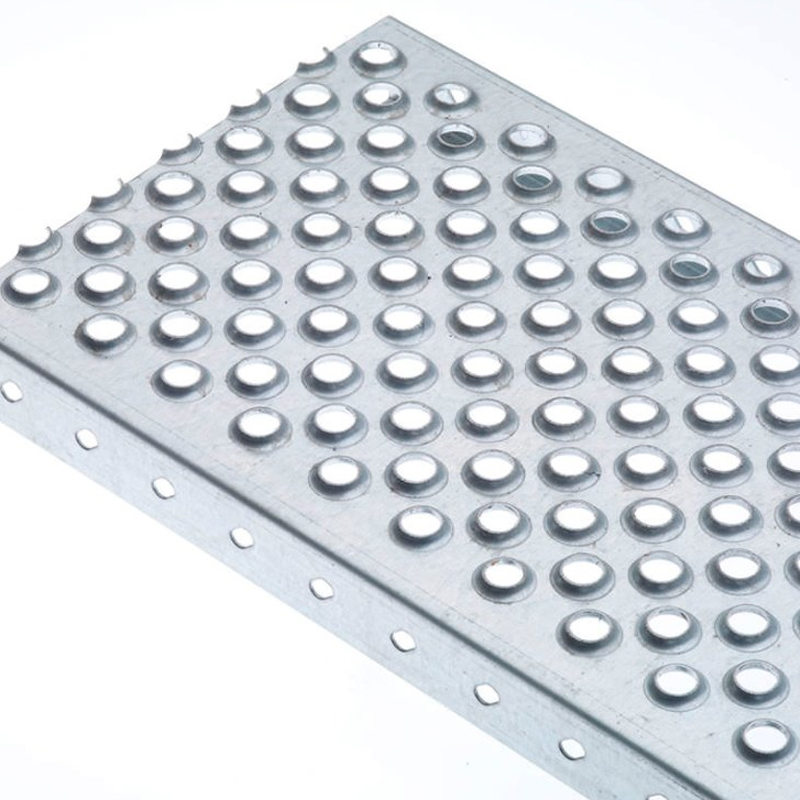
Depending on the application, the system may use raised tread patterns, perforated and formed openings, serrated profiles, industrial grating, bonded anti-slip aggregate, replaceable traction strips, drainage channels or removable contaminant-control mats.
The anti-slip feature must be compatible with cleaning, accessibility, footwear and the expected contaminants.
Drainage and cleaning
Drainage openings must be large enough and correctly positioned to remove liquid, but they must not create trip hazards, catch footwear or weaken critical load paths.
The design should also prevent liquid from collecting on support members below the platform.
Cleaning should not be treated only as a housekeeping issue. It is part of the safety design. The plan should define who cleans the surface, permitted cleaning chemicals, cleaning frequency, rinsing requirements, how wet areas are isolated and how damaged anti-slip treatments are reported.
8. Standard Sheet Sizes, Nesting and Material Utilization
Standard dimensions of 2500 × 1250 mm and 3000 × 1250 mm support repeatable fabrication and export packing.
However, sheet utilization depends on the relationship between stock size and finished part geometry.
Nesting efficiency
Material yield may be expressed as:
Material yield = finished-part area / purchased-sheet area × 100%
This simple area calculation must be adjusted for cutting kerf, edge trimming, defective or protected zones, grain direction, minimum spacing between parts, handling tabs, test coupons and forming allowance.
Finish direction
Satin-brushed panels may need to be nested in one direction only. This can reduce yield compared with non-directional 2B sheet.
A lower theoretical yield may be acceptable when visual consistency is required.
Heat distortion during cutting
Laser cutting introduces localized heat. Narrow strips, large open areas and asymmetrical patterns may distort after cutting.
Possible controls include balanced cutting sequences, reduced heat input, temporary micro-joints, repositioning parts in the nest, post-cut flattening and mechanical cutting for suitable geometries.
Perforated panels and realistic waste claims
Perforation creates reusable scrap only when hole geometry and production method make recovery practical. It can also affect panel flatness because punching introduces repeated local deformation.
The required open-area percentage should be based on drainage, airflow, weight and structural needs rather than visual preference alone.
A fixed statement that cutting waste will always remain below a particular percentage is not technically defensible without drawings. Waste should be calculated for the specific bill of materials and approved nesting plan.
9. Cutting, Forming, Welding and Fabrication Science
Cutting
Laser cutting can produce accurate shapes and small kerfs. Plasma cutting may be economical for thicker material but usually produces a larger heat-affected region and may require more finishing.
Shearing is efficient for straight cuts but can create burrs, edge rollover or slight distortion. Every exposed walking or handling edge should be deburred.
Bending
Successful bending depends on alloy, thickness, rolling direction, bend radius, tooling, surface finish and protective film.
An excessively small bend radius can cause surface cracking or unacceptable thinning. For visible satin sheet, tooling must avoid scratching or cross-grain marking.
Welding 304 and 316
Austenitic stainless steels are generally weldable, but good practice remains necessary.
Important controls include suitable filler metal, controlled heat input, distortion management, removal of harmful heat tint, prevention of carbon-steel contamination, and cleaning of the weld and surrounding area.
Low-carbon versions such as 304L or 316L may be considered for heavily welded fabrications where resistance in the heat-affected zone is important.
Welding 430
Ferritic 430 requires greater procedure control. Heat input and joint design can affect grain structure, toughness and distortion.
For extensively welded load-bearing assemblies, the designer should confirm that the selected 430 product and welding procedure are appropriate.
Heat tint, embedded iron and dissimilar metals
Heat tint is an oxide formed during welding. The chromium-depleted zone beneath severe heat tint can have lower corrosion resistance than the surrounding base metal. Where corrosion performance matters, suitable mechanical or chemical post-weld cleaning should be specified.
Carbon-steel grinding dust or tool particles can become embedded in stainless steel and later rust. Stainless fabrication areas should use segregated tools, clean benches and controlled handling.
When stainless steel is electrically connected to galvanized or carbon steel in the presence of an electrolyte, galvanic corrosion may accelerate attack on the less noble metal. Risk depends on relative surface areas, electrolyte conductivity, wetness duration, joint geometry and protective coatings. Insulating washers, sealants, compatible fasteners and drainage can reduce risk.
10. Inspection, Testing and Quality Documentation
Quality assurance should follow the component from incoming material to installed platform.
Incoming-material inspection
The receiving inspection may include certificate review, heat-number verification, grade confirmation, thickness measurement, width and length checks, diagonal and squareness checks, flatness inspection, visual finish inspection and protective-film condition.
Fabrication inspection
During production, inspectors may verify first-article dimensions, bend angle and radius, hole and perforation geometry, cut-edge quality, weld size and continuity, distortion, finish direction and contamination control.
Finished-panel inspection
The finished panel should be evaluated for rocking or instability, fit to the support frame, fastener alignment, sharp edges, drainability, access-panel restraint, anti-slip feature consistency and visual finish.
Installation inspection
A high-quality panel can still fail when installed on an uneven or weak support system.
Site inspection should confirm actual support spacing, frame level and alignment, connection security, weld completion, gaps and level changes, drainage routes, guardrails and edge protection, and absence of construction damage.
Anti-slip verification and inspection frequency
Where slip performance is safety-critical, the completed surface should be evaluated using a recognized method appropriate to the jurisdiction and expected contamination.
A laboratory result for a clean sample should not automatically be applied to an oily, worn or poorly cleaned field surface.
Inspection intervals should reflect risk. A low-traffic indoor cover may require only periodic review, while a high-traffic oily maintenance walkway may require frequent inspection and cleaning.
11. Corrosion Engineering and Maintenance Strategy
Corrosion control should address specific mechanisms rather than relying on the general statement that stainless steel does not rust.
Pitting corrosion
Pitting produces localized cavities and can progress beneath a small surface opening. Risk increases with chloride concentration, temperature, deposits and insufficient alloy resistance.
Crevice corrosion
Crevice corrosion occurs in narrow shielded areas where oxygen renewal is limited.
Typical locations include overlapping sheets, unsealed fastener interfaces, gasket edges, deposits, poorly drained supports and narrow weld defects.
Designing out crevices is often more reliable than attempting to clean inaccessible joints later.
Galvanic corrosion
Galvanic attack may occur where dissimilar metals are electrically connected and remain wet.
Small galvanized fasteners connected to a large stainless surface can be at greater risk than a large galvanized frame connected to a small stainless component because the cathode-to-anode area ratio affects corrosion intensity.
Stress-corrosion considerations
Austenitic stainless steels can be vulnerable to chloride stress-corrosion cracking under certain combinations of tensile stress, chloride exposure and elevated temperature.
This mechanism is generally less relevant to ordinary cool factory walkways than pitting or crevice corrosion, but it may matter near hot process equipment or heated chemical areas.
Cleaning chemistry and maintenance records
Cleaning products should be selected with knowledge of the grade and contaminant. Strong chloride-bearing cleaners, unremoved residues or carbon-steel brushes can damage the intended corrosion performance.
Cleaning should normally be followed by effective rinsing and drying where practical.
A useful maintenance record documents inspection date, contamination observed, corrosion type and location, loose connections, deformation, damaged anti-slip areas, cleaning method and corrective action.
Trend data can identify whether a material is degrading gradually or whether a local design defect is driving repeated failures.
12. Lifecycle Cost and Engineering Economics
The lowest purchase price is not always the lowest project cost.
A lifecycle-cost model can be written conceptually as:
LCC = initial material + fabrication + installation + maintenance + downtime + replacement − residual value
Initial material and fabrication cost
430 or galvanized steel may have a lower initial price than 304 or 316, depending on the market.
This difference should be compared with the actual service conditions rather than used as the only selection criterion.
A material that is cheaper per kilogram may require more complex welding, coating repair, additional supports, more frequent surface finishing or special handling. Fabrication can therefore change the apparent economic ranking.
Downtime
In a continuously operating factory, downtime can cost more than the replacement material.
A more durable grade may provide value by reducing platform closures, repainting, access scaffolding, safety isolation and production interruption.
Maintenance accessibility
A panel located at floor level is inexpensive to inspect. A panel positioned above operating machinery may require shutdowns, lifting equipment and permits.
Difficult access increases the economic value of corrosion resistance and long service intervals.
Decision logic
430 may be economical when the environment is dry, controlled and easily inspected.
304 may provide the best balance for broad industrial use.
316 may be justified when chloride exposure or maintenance difficulty creates a high consequence of corrosion.
Galvanized steel may be the best option when zinc protection is compatible with the atmosphere, abrasion and fabrication route.
The correct answer depends on total ownership cost, not grade prestige.
13. Supplier-Reported Factory Upgrade Analysis
In a supplier-reported machinery-plant refurbishment, the previous carbon-steel platform system reportedly required repeated rust removal and repainting.
The upgraded design used 2 mm 304 stainless steel with a 2B finish for primary walkways, production-area covers and maintenance platforms, and 0.90 mm 430 brushed stainless steel for supported stair facings and smaller secondary inspection components.
According to the supplied project record, the installation showed no visible rust or major deformation after 24 months of service. Routine oil contamination was reportedly removed through normal cleaning, and annual platform-maintenance labour and material expenditure decreased by more than 40%.
Technical interpretation
- The more corrosion-resistant 304 grade was allocated to the higher-use primary areas.
- The thicker 2 mm sheet was used where impact and platform demand were greater.
- Lower-cost 430 was limited to secondary, supported and less aggressive locations.
- Stainless surfaces eliminated the need for repeated paint-film renewal.
Limits of the evidence
The result should not be treated as a universal performance guarantee.
A scientifically complete case record would also need exact support spacing, design loads, fastening method, anti-slip geometry, chloride concentration, cleaning chemicals, inspection records, baseline maintenance calculation and definition of the reported cost reduction.
The case is useful as an engineering example, but it is not a substitute for project-specific design.
Recommended performance indicators
Future projects should record the number of corrosion defects per inspection, panel deflection at critical spans, number of loose fasteners, slip incidents or near misses, cleaning time per square metre, maintenance labour hours, and replacement and shutdown cost.
These indicators create more reliable evidence than visual statements alone.
14. Regional Application and Ready-to-Use Specification Logic
The material range can support industrial development and factory renovation in Saudi Arabia, the United Arab Emirates, Iraq, Yemen, Egypt, Nigeria, Kenya and other markets.
However, grade selection should not be made by country name alone.
Middle Eastern environments
Important factors can include coastal chloride aerosols, desert dust, high surface temperatures, air-conditioned interior condensation, industrial chemicals and infrequent rainfall followed by concentrated deposits.
A dry-looking environment may still create corrosion when salt and dust remain on a surface and become wet through condensation.
African industrial environments
Conditions vary widely and may include coastal salt exposure, tropical humidity, high rainfall, industrial pollution, limited maintenance access and long transport and storage periods.
Packaging and site storage may be as important as the final grade. Moisture trapped under protective film during prolonged storage can cause staining.
Specification sequence
- Define the component function.
- Record the maximum intended loads.
- Identify the load path and support spacing.
- Classify the corrosion and contamination environment.
- Select 430, 304, 316 or galvanized steel.
- Calculate required thickness and reinforcement.
- Choose the surface finish.
- Specify an anti-slip system for walking areas.
- Design drainage and cleaning access.
- Define cutting, forming and welding requirements.
- Specify certificates and inspections.
- Approve a first production sample.
- Inspect the installed system.
- Establish a maintenance schedule.
Example procurement description
Cold-rolled stainless-steel sheet, grade 304 to the specified edition of ASTM A240/A240M, nominal thickness 2.0 mm, 2B finish, sheet size 3000 × 1250 mm, supplied with traceable mill certification. Finished walkway panels shall include the approved anti-slip geometry, deburred edges, reinforced openings and fixing points shown on the engineering drawings. Panel thickness, span and support arrangement shall be verified for maximum intended loads. Weld discoloration and embedded iron contamination shall be removed. Surface finish, dimensions, flatness, drainage and installed connection security shall be inspected before acceptance.
This type of description is more technically useful than a purchase order stating only “2 mm 304 stainless plate.”
Conclusion
304, 316 and 430 stainless steel sheets, together with hot-dip galvanized alternatives, can provide durable solutions for factory platforms, walkways, maintenance decks, production-floor covers, stair components, machine-access panels and drainage covers.
Their performance does not depend on grade alone.
A reliable installation requires an integrated engineering process covering environmental exposure, corrosion mechanism, maximum intended load, concentrated and dynamic loading, support spacing, panel stiffness, deflection, fatigue, anti-slip performance, drainage, fabrication quality, connection design, inspection and lifecycle maintenance.
304 is a practical general-purpose baseline for many industrial environments. 316 should be evaluated where chlorides, coastal exposure or aggressive cleaning conditions increase localized-corrosion risk. 430 can provide an economical solution for controlled indoor and supported secondary applications. Hot-dip galvanized steel remains valuable where zinc-based protection is compatible with abrasion, chemical exposure and the fabrication method.
The best specification is not necessarily the thickest sheet or the most expensive grade. It is the specification that scientifically matches the material, geometry, support system, environment, safety requirements and intended service life.
SEO Keywords
304 stainless steel sheet, 430 stainless steel plate, 316 stainless steel sheet, industrial stainless steel plate, factory walkway flooring, stainless steel platform sheet, maintenance walkway panel, industrial access platform, 2mm stainless steel sheet, 0.90mm stainless steel sheet, 2500x1250 stainless steel sheet, 3000x1250 stainless steel plate, 2B stainless steel sheet, satin brushed stainless steel, BA finish stainless steel, cold rolled stainless steel plate, hot dip galvanized sheet, anti slip industrial walkway, perforated walkway panel, serrated platform flooring, factory maintenance deck, production floor cover plate, industrial stair tread sheet, inspection platform panel, stainless steel drain cover, corrosion resistant factory flooring, easy clean industrial flooring, oil resistant walkway surface, carbon steel replacement plate, low maintenance platform material, stainless steel fabrication sheet, industrial sheet metal supplier, factory renovation material, machinery plant walkway, warehouse access platform, EPC stainless steel procurement, Middle East industrial flooring, Africa factory construction material, custom stainless steel panels, industrial platform specification.