



High-Corrosion-Resistance 316 Stainless Steel Sheet for Chemical Plants and Saline Environments
High-Corrosion-Resistance 316 Stainless Steel Sheet for Chemical Plants and Saline Environments
Chemical-production facilities, wastewater-treatment plants, coastal industrial parks and saline-soil projects expose metal panels to combinations of chlorides, acidic or alkaline residues, humidity, condensation, heat, deposits and repeated cleaning. These conditions can damage ordinary carbon steel rapidly and may also exceed the practical corrosion-resistance range of 430 or 304 stainless steel.
Type 316 stainless steel is frequently selected for these environments because its molybdenum addition improves resistance to localized chloride attack compared with common 304 stainless steel. However, 316 is not immune to all acids, alkalis, chlorides or temperatures. Its performance depends on chemical concentration, temperature, oxygen availability, flow, deposits, weld condition, crevice geometry, cleaning frequency and actual grade chemistry.
The standard range considered here includes 316, 304 and 430 stainless steel together with hot-dip galvanized alternatives. Available thicknesses include 0.90 mm for supported liners, covers and decorative corrosion-resistant components, and 2 mm for more demanding fabricated panels and frame-supported structures. Standard sheet sizes of 2500 × 1250 mm and 3000 × 1250 mm support batch cutting and custom fabrication. Typical finishes include 2B and satin-brushed surfaces.
1. Why 316 Performs Better in Chloride-Bearing Environments
Stainless steel obtains basic corrosion resistance from chromium, which forms a thin passive film. Chlorides can destabilize that film at defects, inclusions, deposits and crevices. Once a localized site becomes active, corrosion may progress below a small visible opening.
316 normally contains molybdenum in addition to chromium and nickel. The International Molybdenum Association explains that molybdenum additions can substantially improve stainless-steel corrosion resistance in environments containing chlorides and certain strong chemical media.
The worldstainless corrosion-resistance guidance identifies chromium, molybdenum and nitrogen as important contributors to pitting resistance. A commonly used comparison is PREN = %Cr + 3.3 × %Mo + 16 × %N. PREN is useful for comparing alloys, but it is not a service-life equation because surface condition, welds, temperature, deposits, chemical mixtures and crevice design also matter.
316L is the lower-carbon version commonly considered for welded fabrications. Lower carbon reduces the risk of chromium-carbide precipitation associated with certain welding thermal cycles, but it does not remove the need to clean heat tint, prevent iron contamination or eliminate liquid-trapping crevices.
2. Product Standards, Traceability and Procurement
ASTM A240/A240M covers chromium and chromium-nickel stainless-steel plate, sheet and strip for pressure-vessel and general applications. A controlled purchase order should define grade, applicable standard, thickness tolerance, sheet size, finish, edge condition, flatness, mill certificate, heat traceability, protective film, packing and acceptance criteria.
304 and 316 can appear similar to the eye. Grade substitution may remain hidden until the component enters service. Heat-number traceability, mill certificates and, where justified, positive material identification help prevent mixed-grade fabrication.
A 0.90 mm sheet is typically appropriate for continuously supported liners, wall protection, equipment cladding and secondary covers. A 2 mm sheet provides greater stiffness and impact resistance and may be used in frame-supported access covers, fabricated walkway panels or drainage assemblies. Neither thickness is automatically load-bearing; capacity depends on span, support arrangement, stiffeners, perforations, welds, fasteners, concentrated loads and allowable deflection.
3. Selecting 316, 304, 430 or Galvanized Steel
316 is the primary candidate where the environment contains chloride deposits, marine aerosols, saline wash water or chemical contamination beyond the practical range of 304. It should still be reviewed carefully in direct seawater splash, hot concentrated chloride solutions, reducing acids, strong chemical mixtures or uncleaned severe marine exposure. Duplex, super-austenitic, nickel-alloy or lined systems may be required where 316 is outside its operating range.
304 offers a strong balance of cost, formability, weldability and general corrosion resistance. It can be suitable for dry or moderately humid chemical buildings where direct chloride and aggressive chemical exposure are controlled.
430 is a ferritic stainless steel useful for controlled indoor, non-aggressive and cost-sensitive applications such as decorative facings, machine guards and wall panels. It should not be marketed as equivalent to 316 for chemical or saline service.
Galvanized steel may be suitable for selected support frames or non-chemical areas, but zinc can be attacked by some acidic and strongly alkaline media, and repeated abrasion can remove the coating.
| Exposure | 430 | 304 | 316/316L | Engineering comment |
|---|---|---|---|---|
| Dry indoor utility area | Possible | Very suitable | Usually conservative | Select by fabrication and lifecycle cost |
| Humid chemical building | Conditional | Possible | Strong candidate | Review condensation and cleaners |
| Coastal salt deposition | Generally unsuitable | Conditional | Preferred starting point | Cleaning and crevices remain critical |
| Chloride wastewater | Generally unsuitable | Conditional | Common candidate | Check concentration, temperature and immersion |
| Direct seawater splash | Unsuitable | Often inadequate | May still be insufficient | Consider higher-alloy materials |
4. Chemical Compatibility
Chemical corrosion cannot be predicted from the words acid, alkali or chemical plant alone. The same alloy may perform well in a dilute solution at room temperature and fail in a hotter or more concentrated version of the same chemical.
A compatibility assessment should define chemical identity, concentration, normal and maximum temperature, pH, chloride content, oxidizing conditions, flow velocity, wet-dry cycling, impurities, contact duration, crevices and deposits.
316 can perform well in certain dilute or moderately aggressive environments, but it is not universally resistant to hydrochloric acid, hot concentrated sulfuric acid or reducing mixtures. Hydrochloric acid is especially aggressive because it combines acidity and chlorides. Hot concentrated caustic service may also exceed the practical range of standard 316.
Real plants expose materials to mixtures of process residues, cleaning agents, salts and temperature cycles. Maintenance chemicals must therefore be included in the material review.
5. Pitting, Crevice Corrosion and Relevant Tests
Pitting creates localized cavities and can progress beneath a small surface opening. Risk generally increases with chloride concentration, temperature, deposits, surface damage and inadequate alloy resistance.
Crevice corrosion develops in shielded zones where liquid movement and oxygen renewal are restricted, including overlaps, washers, gaskets, panel-support interfaces, deposits and incomplete welds. Local chemistry inside a crevice can become more acidic and chloride-rich than the surrounding solution.
ASTM G48 provides test methods for evaluating pitting and crevice-corrosion resistance of stainless steels and related alloys in oxidizing chloride environments. Results must be interpreted according to the method, temperature, specimen preparation and acceptance criterion.
6. Limits of a 96-Hour Salt-Spray Claim
ASTM B117 describes the apparatus, procedure and conditions used to create a salt-fog environment. It does not prescribe one universal exposure period for every product and does not convert test hours directly into field service life.
A statement such as “316 withstands more than 96 hours of salt spray” is incomplete unless it identifies the test edition, chamber conditions, specimen grade, finish, exposed edges, acceptance criterion, observed corrosion and accredited report.
A 96-hour result does not prove a three-year or thirty-year field life. Real service involves wet-dry cycles, deposits, temperature changes, cleaning and variable chemicals. Qualification may require certificate review, ASTM G48 testing, chemical-specific coupon exposure and field trials.
7. Structural Performance and Load Logic
Corrosion resistance and structural capacity are separate questions. A corrosion-resistant 316 sheet can still deflect or fail if support is inadequate.
0.90 mm sheet is suited to supported liners, splash guards, enclosures and protective skins. Forming ribs or folds can improve stiffness, but the sheet should not be described as a self-supporting industrial walkway without calculation or test data.
2 mm sheet can be used for frame-supported chemical-platform panels, access covers, reinforced trench covers, equipment-base protection and maintenance-walkway skins. It still requires defined span, stiffeners, connection layout and load limits.
OSHA 29 CFR 1910.22 requires walking-working surfaces to support their maximum intended load and remain free of recognized hazards including corrosion, leaks and spills. Engineering assessment should include dead load, pedestrian load, maintenance equipment, concentrated wheels, impact, vibration, openings, fatigue and support-frame corrosion.
8. 2B and Satin Finishes in Chemical Service
2B is a smooth cold-rolled finish widely used because it is consistent, fabrication-friendly and relatively easy to clean. A smoother finish can reduce contaminant retention, but it does not solve crevice, weld or drainage problems.
Satin finish provides a directional appearance and can make some handling marks less visible. It should not automatically be described as more corrosion resistant or anti-slip than 2B. A coarse or damaged brushed surface may retain more deposits, so abrasive grade, roughness, direction and post-fabrication restoration should be controlled.
Stainless steel is a solid corrosion-resistant alloy without a sacrificial paint film, but fabricated surfaces may still contain scratches, embedded iron, weld oxide, grinding damage and trapped residues.
9. Anti-Slip Design
Smooth stainless sheet can become highly slippery when contaminated with chemicals, oil, sludge or water. Corrosion resistance does not provide traction.
The UK Health and Safety Executive states that workplace floors should remain suitable for the work activity and that areas subject to frequent contamination should still allow safe movement.
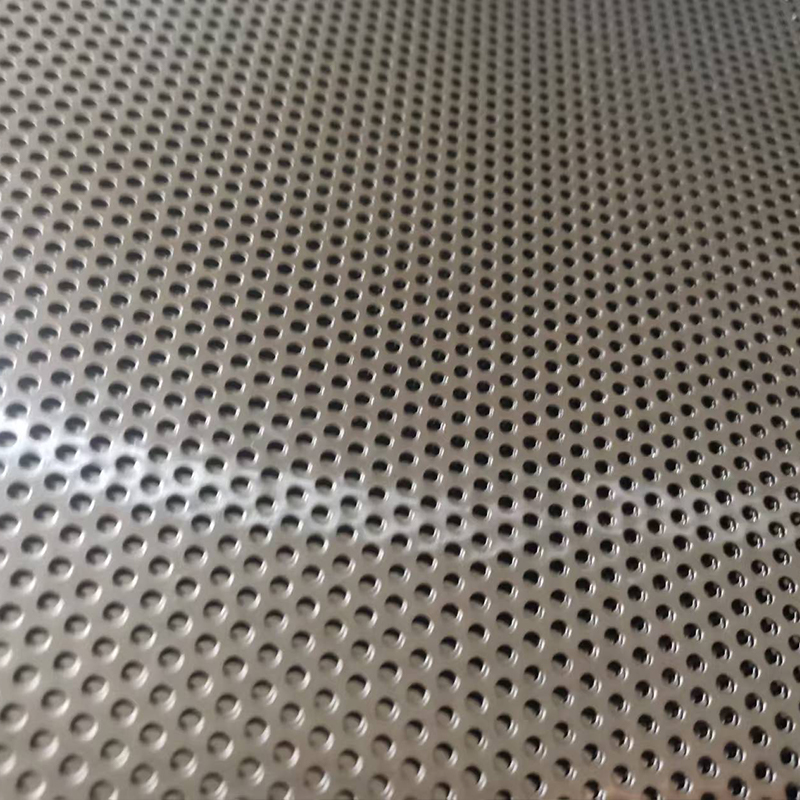
Possible controls include serrated perforations, raised embossing, industrial grating, chemically compatible anti-slip coatings, replaceable traction strips, drainage channels and suitable footwear. The system should be assessed under the expected contaminant rather than only in clean dry conditions.
10. Fabrication and Welding
Laser cutting, shearing, punching and waterjet cutting can be used depending on geometry and volume. Exposed edges should be deburred and inspected for oxide, contamination and crevice-forming geometry.
Bend radius, rolling direction, tooling and protective film influence the finished surface. Excessive strain can create cracking or thinning around small-radius bends and perforations.
Welding produces heat tint, distortion and a heat-affected zone. For corrosive service, the specification should define welding procedure, compatible filler, heat-input control, back purging where required, heat-tint removal, pickling or passivation where specified, final rinsing and cleanliness acceptance.
Carbon-steel particles from shared tools or grinding can become embedded and later rust. Stainless fabrication areas should use clean work surfaces and segregated tooling where practical.
Continuous, properly finished welds may be preferable to intermittent welds where chemical liquid can enter gaps. Overlaps and inaccessible backing plates should be minimized or sealed with a compatible system.
11. Inspection and Qualification
Incoming inspection should confirm grade, heat number, mill certificate, thickness, dimensions, surface finish, flatness, protective film and absence of obvious contamination.
Finished panels should be checked for dimensions, weld quality, heat-tint removal, edge safety, anti-slip geometry, drainage, fastener compatibility, stability and surface restoration.
Depending on risk, qualification may include positive material identification, ASTM G48 testing, chemical-specific immersion coupons, welded-sample testing, site trials and periodic pitting-depth or remaining-thickness inspection. The sample should represent the finished product, not only untouched mill sheet.
12. Core Problems and Matched Solutions
Rapid pitting in saline deposits: select an appropriate molybdenum-bearing grade, reduce deposit retention, improve drainage, eliminate crevices and verify chloride and temperature limits.
Coating failure on carbon steel: compare solid stainless steel with the complete coating lifecycle, including surface preparation, abrasion, access, repair and downtime.
304 corrosion in severe coastal service: review chloride deposition, rain washing, temperature, crevices and cleaning frequency; upgrade where 304 is outside the exposure range.
Chemical residues trapped in joints: redesign for drainage and cleaning, avoid intermittent crevices and use compatible seals.
Sheet deformation: calculate span, add stiffeners, reinforce openings and distribute point loads. Greater corrosion resistance does not increase geometric stiffness.
Slippery walkways: use tested anti-slip geometry, drainage, contamination control and suitable footwear. Satin finish alone is not a validated anti-slip system.
13. Supplier-Reported Persian Gulf Chemical-Park Case
A supplier-reported fine-chemical industrial-park project near the Persian Gulf involved high humidity, airborne salt and intermittent acidic and alkaline vapours. The earlier 304 installation reportedly developed widespread visible pitting and staining within approximately six months.
The replacement reportedly used 2 mm 316 satin sheet for operation platforms, equipment-base covers, trench closure panels and wastewater-station maintenance walkways.
According to the supplied information, after 36 months the installation showed no reported visible rust staining, major deformation or confirmed functional loss. The supplier also reported an approximate 45% maintenance-cost reduction.
This case supports the principle that upgrading from 304 to a molybdenum-bearing grade can improve performance in chloride-bearing exposure, but it is not a universal guarantee. Independent verification would require alloy certificates, chloride data, temperature history, surface roughness, support spacing, load data, anti-slip pattern, cleaning schedule, pit-depth measurements and the baseline used for the cost comparison.
A statement such as capacity loss below 5% requires structural testing, measured section loss or calculation. Visual inspection alone cannot establish a precise percentage.
14. Regional Selection
Gulf coastal and petrochemical environments in the United Arab Emirates, Qatar, Kuwait and Oman can combine chloride deposition, heat, humidity, dust, industrial pollution and condensation. 316 is a logical starting point for many exposed components, but severe splash zones, direct seawater contact, inaccessible crevices or low cleaning frequency may require duplex or higher-alloy stainless steel.
Malaysia, Indonesia and Vietnam can combine marine salts, high humidity, rainfall, biological deposits and industrial contamination. Exposed areas may be rain-washed while sheltered areas retain damp salt. Design should prioritize drainage, ventilation, easy cleaning and avoidance of concealed crevices.
Saline soil and wastewater may contain chlorides, sulfates, microorganisms, low oxygen and stray current. Immersed, buried or continuously wet exposure may be more severe than atmospheric coastal service and should be reviewed by a corrosion specialist.
15. Lifecycle Cost
Lifecycle cost can be expressed conceptually as material + fabrication + installation + inspection + cleaning + repair + downtime + replacement − residual value.
316 may be economically justified where chloride exposure makes 304 unreliable, coating repair requires shutdown, access is difficult, failure consequences are high or the required service period is long.
For dry, controlled and easily maintained indoor areas, 304 or 430 may be sufficient. For direct seawater, hot concentrated chlorides, strong reducing acids or severe crevices, 316 may be insufficient.
16. Engineering Specification Checklist
- Define the exact chemical, chloride and temperature exposure.
- Identify whether the component is a liner, cover, walkway or structural assembly.
- Set uniform and concentrated loads.
- Define support spacing, stiffeners, edge restraint and openings.
- Select 316 or 316L against the required standard.
- Confirm whether 0.90 mm or 2 mm suits the finished geometry.
- Select stock size according to nesting and finish direction.
- Specify 2B or satin finish with an approved sample.
- Design drainage and eliminate liquid-trapping crevices.
- Add a verified anti-slip system.
- Qualify cutting, bending, welding and post-weld cleaning.
- Require heat traceability and mill certificates.
- Define G48, chemical coupon or field testing where required.
- Treat B117 duration as a test result, not a service-life forecast.
- Inspect the installed support frame, connections and drainage.
- Establish cleaning and corrosion-monitoring intervals.
Conclusion
316 stainless steel sheet is an important material for chemical plants, coastal industrial parks, saline wastewater facilities and chloride-bearing environments because molybdenum improves resistance to localized corrosion compared with common 304 stainless steel.
Its value is greatest when the specification considers chemical identity, concentration, temperature, chloride level, wet-dry cycling, deposits, crevices, surface finish, welding, sheet thickness, load path, support spacing, slip resistance, drainage and maintenance.
A 96-hour salt-spray result can form part of a quality record, but it is not a universal guarantee of field life. ASTM B117 defines the salt-fog environment rather than a single durability rating. ASTM G48 and chemical-specific testing may provide more relevant information for pitting and crevice-corrosion risks.
The correct product is not simply 316 stainless steel. It is a fully defined and verified system combining grade, thickness, geometry, finish, fabrication method, support structure, safety controls and maintenance plan.
SEO Keywords
316 stainless steel sheet, 316 stainless steel plate, 316L stainless steel sheet, chemical resistant stainless steel, corrosion resistant steel plate, chloride resistant stainless steel, coastal stainless steel sheet, marine grade stainless steel plate, chemical plant walkway, chemical platform flooring, wastewater treatment platform, saline environment steel sheet, salt resistant stainless steel, 2mm 316 stainless steel plate, 0.90mm 316 stainless sheet, 2500x1250 stainless steel sheet, 3000x1250 stainless steel plate, 2B 316 stainless steel, satin 316 stainless steel, molybdenum stainless steel, pitting resistant stainless steel, crevice corrosion resistant steel, chemical trench cover, stainless steel drain cover, acid resistant platform sheet, alkali resistant steel panel, petrochemical platform material, coastal industrial flooring, anti slip chemical walkway, perforated 316 walkway panel, 316 stainless fabrication sheet, chemical equipment cover plate, wastewater maintenance walkway, Persian Gulf chemical project, Middle East stainless steel supplier, Southeast Asia coastal steel, ASTM A240 316 sheet, ASTM G48 stainless steel, salt spray tested stainless steel, high corrosion resistance plate.