



How to Choose Sheet Thickness for Supermarket Perforated Fascia Panels
How to Choose Sheet Thickness for Supermarket Perforated Fascia Panels
Overview
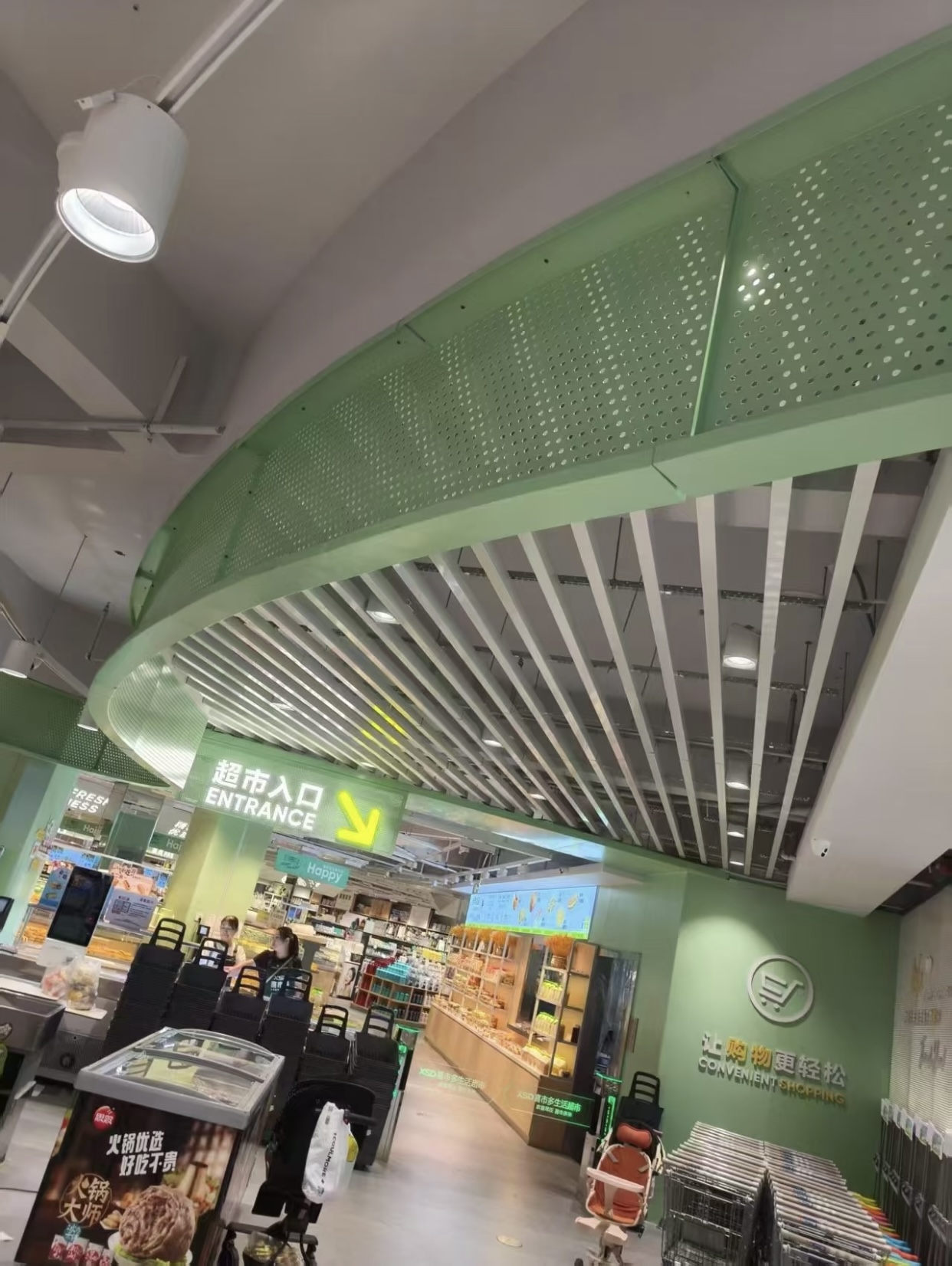
Supermarket perforated fascia panels are widely installed above checkout counters, aisle signage, fresh food and grocery zones. These suspended header panels face high risks of sagging and bending caused by self-weight and punching residual stress. This practical selection guide is built for retail shopfitters. Learn how span, open area and edge folding affect sagging of backlit aluminum perforated header panels, with structural tips for checkout, aisle and fresh zone fascia.
1. Application Scenarios
Perforated fascia is the signature decorative header for modern supermarket fit-outs, running above shopping aisles, checkout stations, fresh produce sections, snack zones and household goods displays. Many retail designers pair these fascia panels with Acoustic Perforated Panels when the store needs to reduce echo and background noise from shopping crowds and refrigeration units.
Visible front fascia requires consistent flatness and neat hole alignment for brand presentation. If the project combines wall cladding and overhead signage headers, designers can match the hole pattern with Decorative Perforated Panels to maintain unified visual style across the whole retail space. For maintenance platforms or walkable overhead access frames nearby, Anti-Slip Perforated Panels are recommended instead.
Different supermarket zones carry unique environmental and structural demands. Fresh food and seafood areas have persistent moisture and cold air condensation, so corrosion resistance becomes a priority. Dry grocery and snack zones focus mainly on appearance and long-term flatness. Checkout zones usually adopt long continuous fascia with larger single panel length, which brings higher sagging risk than short segmented headers.
Backlit fascia adds extra load constraints. Built-in LED light strips, diffuser films and wiring increase dead load on thin perforated sheets. Many shopfitters underestimate this additional weight and select insufficient thickness, which triggers slow deformation months after opening. Indoor temperature fluctuation also creates minor thermal stress, amplifying panel deflection over time.
2. Specification Parameters
Sheet thickness is the core factor controlling anti-sag performance for suspended supermarket fascia. The mainstream market scheme follows proven specifications widely adopted by fresh retail chains. 1.2 mm is the top recommended standard thickness for most supermarket fascia projects. It fits single panel width ≤1200 mm and length within 2000 mm, when equipped with folded edges or rear reinforcing frames.
1.2 mm panels strike a balanced performance between rigidity, weight and project budget. They retain good flatness after punching, resist downward bending under self-weight and backlight load, and remain the most common specification for standard supermarket aisle, grocery and fresh zone fascia. Even at medium open area, properly leveled 1.2 mm galvanized or aluminum sheets keep straight lines for a long time.
1.0 mm is the economical alternative. It works only for narrow segmented panels with short spans, where dense rear square tube support frames are fully installed. Without adequate back reinforcement, wide 1.0 mm perforated fascia will gradually sag at the panel center, forming an obvious concave gap and ruining the straight horizontal sightline of store signage.
0.8 mm thin sheets are only suitable for small decorative fascia with limited width, short length and low open area. It is not advised for long continuous headers. High open area punching removes substantial base material and weakens panel rigidity, making thin sheets extremely vulnerable to wavy deformation.
Material options include galvanized steel, aluminum alloy and 304 stainless steel. Galvanized steel with powder coating is the first pick for regular indoor supermarkets due to stable rigidity and competitive cost. Aluminum is lighter and easier for bending, but its lower rigidity requires thicker gauges or tighter support spacing. 304 stainless suits humid fresh and seafood sections for rust prevention. ASTM A653 and ASTM B209 define material mechanical properties for these substrate options.
3. Design Key Points
Single panel span directly decides deflection risk. Longer unsupported span multiplies sagging tendency, even with adequate sheet thickness. Designers should split extra-long fascia into segmented panels rather than using one full-length sheet. Splitting joints can be hidden with decorative trim to keep clean visual effects.
Open area must be factored into thickness selection. Higher open area releases more internal stress and reduces effective cross-section rigidity. If the fascia uses large holes and high open area, upgrade to thicker sheet or add back reinforcing ribs, instead of sticking to the standard thickness for low open area designs.
Edge folding treatment is a low-cost but highly effective stiffening method. Folded borders greatly improve the overall rigidity of perforated fascia and reduce mid-span sagging. Panels without folded edges rely entirely on rear frames for support, demanding denser keel layout and higher construction cost.
Backlit fascia needs special dead-load checking. LED modules, wiring and light diffusers continuously apply extra load. For backlit headers, we recommend raising the thickness one grade or adding hidden back frames, compared with non-illuminated perforated fascia of the same size.
Hanging point layout also matters. Hangers should be evenly distributed along the back frame, not concentrated only at both ends of the panel. Uneven hanging points create uneven stress distribution and local distortion. ASCE structural design notes provide dead load and deflection reference for thin metal suspended cladding.
4. Industry Standards
Multiple international standards support structural and surface specification for retail metal fascia. ASTM A653 covers galvanized steel sheet mechanical and coating requirements, while ASTM B209 sets rules for aluminum alloy panels. ISO 14122 provides general safety guidance for suspended metal components in public commercial spaces.
Architectural fascia flatness and visual tolerance can refer to metal cladding fabrication specifications from ASCE. If acoustic improvement is required together with perforated fascia, Acoustical Society of America test standards guide sound absorption performance verification. Architectural Digest also showcases many retail perforated header designs from global supermarket projects.
Site acceptance should check sheet thickness, open area consistency, flatness deviation, folding quality and hanging frame strength. Sagging defects usually cannot be fixed easily after installation. It is difficult to adjust deformed perforated panels on site without disassembly, which causes rework delays and extra shopfitting costs.
Clear deflection limits should be written into shopfitting contracts. A commonly accepted rule is maximum allowable sag below 1/360 of the unsupported span, to guarantee straight visual lines for supermarket signage headers.
5. Case Analysis
A fresh supermarket chain originally chose 1.0 mm aluminum perforated fascia for continuous 1800 mm wide aisle headers, without rear reinforcing frames. Within four months after installation, obvious center sag appeared on dozens of fascia panels. The brand replaced them with 1.2 mm galvanized panels with folded edges and light back frames, and the flatness stayed stable.
A snack retail shop selected 0.8 mm aluminum sheets for backlit perforated checkout fascia. High open area plus LED light weight caused wavy deformation. Our team revised the specification to 1.2 mm galvanized perforated panels and optimized hanging spacing, solving the distortion issue for follow-up store rollout.
A seafood supermarket in humid coastal area adopted 1.2 mm 304 stainless perforated fascia with edge sealing treatment. Reasonable segmentation and folded stiffeners helped the panels resist moisture corrosion and maintain flatness during long-term operation.
These cases reveal three frequent mistakes: selecting thin gauge for long span fascia, ignoring extra dead load from backlit LED systems, and skipping folded edge reinforcement. Early thickness review with the perforated panel supplier avoids on-site deformation and brand image loss.
📞 Tel/WhatsApp: +86 180 2733 7739
📧 Email: jtsw58@gmail.com
🌐 Website: perforatedmetalpanel.com
📸 Instagram: instagram.com/jintongperforatedmetal
💬 WhatsApp: shorturl.at/jdI6P
🔗 LinkedIn: Andy Liu
▶ YouTube: Jintong-n7d
🌐 Web WhatsApp: web.whatsapp.com
👍 Facebook: facebook.com/me
📱 Direct WhatsApp Chat: https://api.whatsapp.com/send?phone=8618027337739
If you are designing perforated fascia for supermarket fit-outs, share panel width, length, open area, backlit requirement and material preference. We can recommend proper thickness, stiffener layout and provide formal quotation. This guide helps retail shopfitters select sheet thickness and prevent sagging perforated supermarket headers.
#supermarketperforatedfascia#perforatedheaderpanel#retailshopfitting#backlitperforatedfascia#perforatedpanelsagcontrol#fasciaedgefolding#perforatedspanlimit#grocerystorefascia#freshzonedecoration#checkoutsignagepanel#galvanizedperforatedfascia#aluminumperforatedheader#stainlesssteelfascia#astma653#astmb209#iso14122#metalcladdingdeflection#perforatedopenarea#retailinteriordesign#supermarketceilingheader#foldedstiffener#ledbacklitfascia#perforatedpanelflatness#shopfitterguide#perforatedpanelfactory#jintongperforatedmetal#customperforatedfascia#sagresistantpanel#supermarketsignage#moistureresistantfascia#perforatedaisleheader#commercialretailfascia#metalheaderfabrication#perforationstress#retailfitouttender#fasciahangingsystem#freshsupermarketdesign#snackstorefascia#seafoodshopheader#perforatedsignpanel