


Do Hexagonal Perforated Sheets Produce Burrs?
Do Hexagonal Perforated Sheets Produce Burrs?
Overview
Hexagonal perforated metal sheets are widely used for supermarket fascia, decorative screens, hoarding panels, display boards and filtration components. Unlike round holes, hexagonal holes have sharp angular corners that are prone to burr formation during punching. This guide explains where burrs appear, key influencing factors, two common deburring processes, and ISO/ASTM quality standards for decorative fascia, screens and guard panels.
1. Application Scenarios
Hexagonal perforated metal sheets are a popular decorative and functional perforated option across architectural and industrial projects. Supermarket suspended fascia, interior decorative screens, outdoor advertising hoardings, equipment safety guards and filter separation plates are typical application scenarios. When projects require both sound absorption and decorative effects, engineers often match these hexagonal sheets with Acoustic Perforated Panels for integrated acoustic facades.
For high-end lobbies, exhibition backdrop walls and commercial signage that demand consistent visual presentation, designers can coordinate hole patterns with Decorative Perforated Panels to maintain unified design language. If panels are installed on maintenance walkways or access platforms where operators may step on the surface, Anti-Slip Perforated Panels are recommended to meet safety requirements.
Different application scenarios set different tolerance requirements for burrs. Industrial filter plates and rear hidden guard structures usually allow minor residual burrs as long as they do not affect fluid flow or assembly. Visible decorative fascia and hand-touchable partition screens demand smoother edges, because exposed burrs not only ruin the refined appearance but also bring scratch risks for staff and customers.
Outdoor hoarding panels face extra considerations. Unremoved burrs can form tiny stress concentration points. When exposed to wind load, temperature cycling and atmospheric corrosion, these sharp edges are more likely to start rust spots and local cracks, shortening the service life of the whole panel. Many fabricators overlook this long-term risk and only focus on flatness and hole position accuracy.
2. Specification Parameters & Burr Influencing Factors
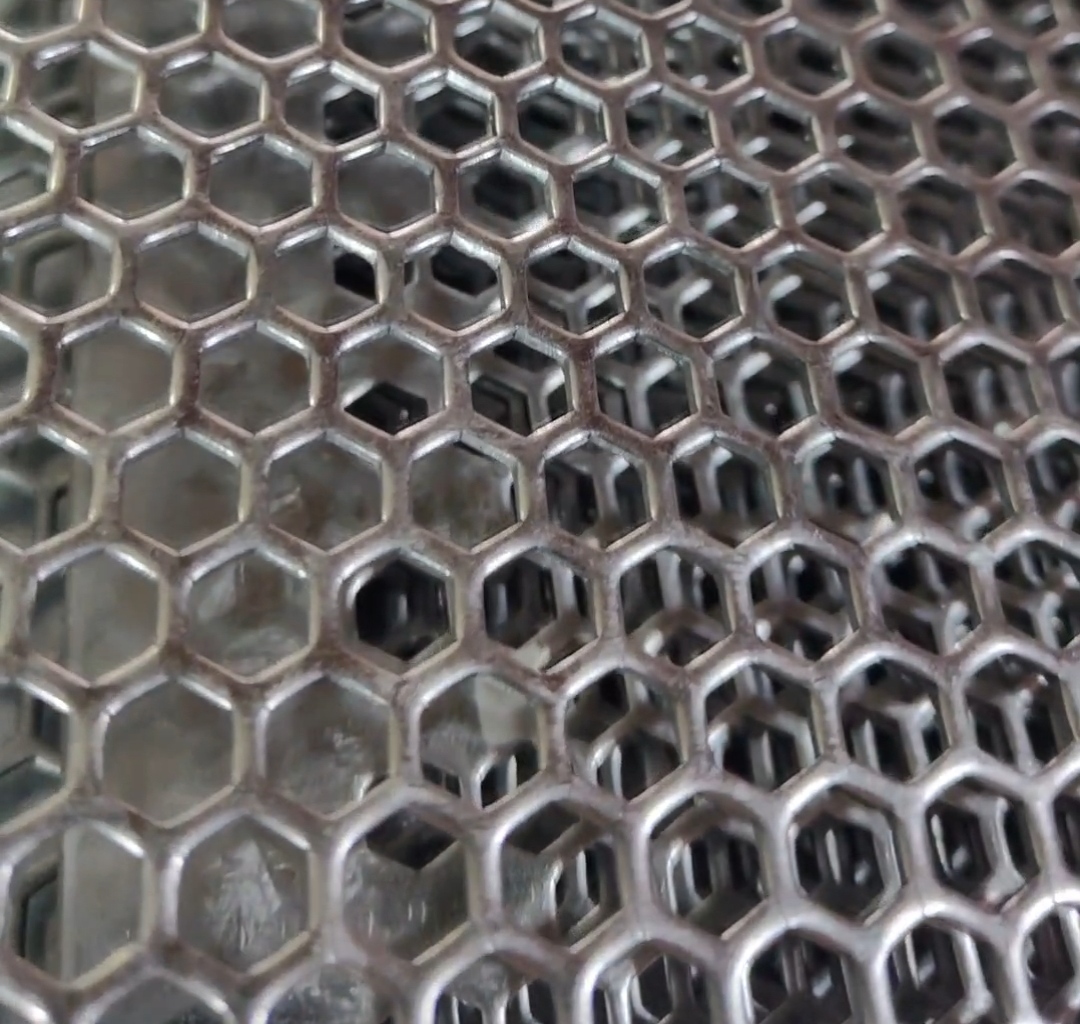
Hexagonal hole punching naturally generates minor burrs, which is a normal result of the mechanical blanking process. Compared with circular holes, the six sharp corners of hexagonal holes are the main burr formation zones. Stress concentrates at these angular positions. When the punch shears and tears the metal material, the fracture surface is uneven, and raised burrs tend to form along the corner edges.
Multiple variables decide the size and severity of burrs. Thicker plates and higher material hardness will create more obvious burrs under the same mold condition. Worn punching dies or improperly adjusted die clearance are also major triggers. Thin sheets at 1.0 mm and 1.2 mm can achieve very small, barely visible burrs when mold parameters are precisely calibrated.
Material selection also changes burr performance. Galvanized steel forms relatively soft burrs that are easier to polish away. Stainless steel has high tensile strength, and its burrs are harder and sharper, requiring longer processing time for full deburring. Aluminum hexagonal perforated sheets produce thin, flaky burrs that may fall off partially after vibration, yet leftover sharp edges still pose scratch hazards.
Open area and hole pitch cannot be ignored either. Dense hexagonal hole layouts with narrow web widths create more continuous shearing zones. The repeated punching action accumulates local stress, which may worsen edge tearing and burr generation. ISO 1461 and ASTM A653 set reference quality benchmarks for the surface finish and edge condition of punched metal panels.
3. Design Key Points
Designers should define deburring requirements at the early drawing stage, instead of adding extra requests after production. Clarify whether the panel is non-deburred, tumbled deburred or precision sanded and chamfered. Vague terms such as “smooth surface” often lead to acceptance disputes between manufacturers and contractors.
If the finished panel will be laminated, veneered or backlit, precision deburring and light chamfering are strongly suggested. Residual burrs can puncture decorative films, diffuser sheets or paint layers during installation and long-term thermal expansion, causing local coating peeling and visible defects on the finished surface.
Mold maintenance schedule directly affects batch consistency. Continuous mass punching wears the cutting edge of hexagonal punches step by step. A sharp new die delivers clean fracture lines, while a dull die will produce jagged, heavy burrs. Reliable manufacturers arrange regular die grinding and clearance inspection for hexagonal hole tooling.
Burr control should be matched with panel thickness. For thin decorative sheets below 1.2 mm, excessive heavy grinding may distort the panel flatness and introduce new undulation. Light tumble finishing is more suitable here. Thick guard plates above 2.0 mm can withstand aggressive sanding without obvious deformation. ASCE metal fabrication guides include edge finish tolerance references for architectural metalwork.
4. Industry Standards
A series of international standards regulate metal punching quality, surface finish and edge safety. ASTM A653 covers galvanized steel substrate and surface quality requirements. ISO 1461 specifies hot-dip galvanized coating quality for perforated metal components. ISO 9013 defines thermal cutting and mechanical shearing edge quality classification, which can be referenced for punched edge evaluation.
For commercial decorative facades requiring strict visual control, Architectural Digest publishes many high-spec perforated metal project specifications, including edge finish acceptance rules. When hexagonal perforated sheets are used for acoustic panels, the Acoustical Society of America notes that rough burr edges have negligible impact on overall sound absorption, but smooth edges remain required for safety and aesthetics.
Third-party inspection for decorative projects usually uses a visual check and touch test. High-grade projects adopt a burr height gauge to quantify residual burr height, rather than only subjective hand feeling. This quantitative index should be written into tender documents to unify the acceptance standard.
It is important to distinguish functional tolerance and cosmetic tolerance. Industrial mechanical guards prioritize safety burr removal, while architectural fascia emphasizes uniform visual effect. Acceptance standards for these two categories should not be mixed.
5. Case Analysis
A supermarket fresh zone fascia project selected 1.2 mm galvanized hexagonal perforated sheets. The client only requested tumble deburring. After roller polishing, burrs were removed effectively; the surface felt smooth and met the budget requirement for large-area fascia. The panels were installed smoothly without scratching installers.
An exhibition hall backdrop screen adopted 1.0 mm 304 stainless hexagonal perforated sheets for close-view display. Initial production with only tumble finishing left tiny sharp corner burrs visible under spotlight. We upgraded the process to precision sanding and micro chamfering. The finished edges were clean, and the screen passed strict site acceptance.
A mechanical safety guard project used 2.5 mm carbon steel hexagonal perforated plates. The client skipped deburring to cut cost. On-site inspection found sharp burrs on every hexagonal corner. The factory reprocessed the whole batch by tumble deburring to eliminate hand injury risks before delivery.
These cases show three common mistakes: ignoring sharp-corner burr characteristics of hexagonal holes, choosing insufficient deburring process for close-range decorative panels, and removing deburring steps for safety guard panels to save cost. Confirming burr grade and processing method in advance avoids rework and delivery delay.
Many buyers underestimate the extra processing cycle of precision deburring. Tumbling takes a short lead time, while sanding and chamfering require longer production scheduling. Early process confirmation helps arrange the production timeline properly.
📞 Tel/WhatsApp: +86 180 2733 7739
📧 Email: jtsw58@gmail.com
🌐 Website: perforatedmetalpanel.com
📸 Instagram: instagram.com/jintongperforatedmetal
💬 WhatsApp: shorturl.at/jdI6P
🔗 LinkedIn: Andy Liu
🌐 Web WhatsApp: web.whatsapp.com
👍 Facebook: facebook.com/me
📱 Direct WhatsApp Chat: https://api.whatsapp.com/send?phone=8618027337739
If you plan hexagonal perforated sheets for supermarket fascia, decorative screens or safety guards, share material, thickness, hole size and deburring grade. We will recommend suitable punching and finishing processes and provide formal quotation. This guide helps you understand hexagonal hole burr formation, deburring options and quality standards for your perforated metal projects.
#hexagonalperforatedsheet#hexholeperforatedmetal#perforatedsheetburr#deburredperforatedpanel#supermarketperforatedfascia#decorativeperforatedscreen#hoardingperforatedpanel#stainlesshexperforatedplate#galvanizedhexagonalperforation#metalpunchingquality#perforatedguardpanel#iso9013#astma653#iso1461#tumbledeburring#precisionchamfering#architecturalperforatedmetal#commercialfasciafabrication#perforatedholeedgefinish#metalhoardingpanel#displayboardperforation#perforatedpanelfactory#jintongperforatedmetal#customhexperforatedsheet#punchedmetalburrcontrol#acousticperforatedassembly#safetyguardperforatedplate#metaldecorationscreen#perforationmoldmaintenance#hexholemetalpanel#metalfabricationtolerance#perforatedsheetacceptance#stainlesspunchingfinish#outdoorhoardingmetal#retailfitoutperforation