


Advantages of Crocodile Mouth Anti-Slip Plate VS Standard Checkered Plate
Advantages of Crocodile Mouth Anti-Slip Plate VS Standard Checkered Plate
Overview
Industrial walkways, stair treads and ship decks require reliable slip resistance. Many buyers pick standard checkered plate for low upfront cost, ignoring its weakness in wet, oily environments. Crocodile mouth anti-slip plate, also called grip strut perforated sheet, outperforms checkered plate in traction, drainage, wear life and structural rigidity.
This technical guide compares their friction mechanism, drainage performance, wear characteristics, load capacity and maintenance cost. It includes a real oily workshop retrofit case, ISO/ASTM standards and scenario-based selection advice. For noise-control metal panels, view our Acoustic Perforated Panels. For architectural cladding, check Decorative Perforated Panels.
1. Case Analysis: Oily Production Workshop Checkered Plate Triggered Recurring Slip Hazards
A precision machinery component manufacturer fitted its production workshop walkways and maintenance platforms with hot-rolled checkered plate. The facility ran continuous CNC machining shifts, with cutting oil, coolant and fine metal shavings spilling across floor surfaces each day. The procurement team selected checkered plate mainly because it was easy to source and cheaper at first glance, assuming diamond embossments would deliver stable anti-slip grip for operators and pallet truck staff.
Within three months, constant foot traffic and pallet wheel abrasion wore down the shallow raised diamond textures. Oil settled and accumulated inside the plate’s recessed grooves, forming a continuous thin oil film that eliminated friction. Multiple slip incidents occurred; two maintenance technicians sustained bruises and lacerations while moving heavy toolboxes. The site team tried anti-slip paint as a budget fix, but paint peeled quickly under oil contamination and repeated friction. Each recoating required production shutdowns, bringing extra labour costs and delivery delays.
Our Jintong Perforated Metal technical team completed an on-site inspection, collected surface friction test data and assessed the existing support framing. We proposed replacing the checkered plate with hot-dip galvanized crocodile mouth anti-slip plate. Our factory strictly controlled punching clearance, serration height, folding rigidity and pre-drilled mounting holes to perfectly match the original frame layout. After installation, oil, coolant and metal debris fall freely through gaps between serrated teeth rather than pooling on the walking surface. Slip accidents at this site stopped entirely after the retrofit. For heavy-duty access platforms, maintenance walkways and stair treads, review our Anti-Slip Perforated Panels.
2. Specification Parameters & Authoritative Industry Standard References
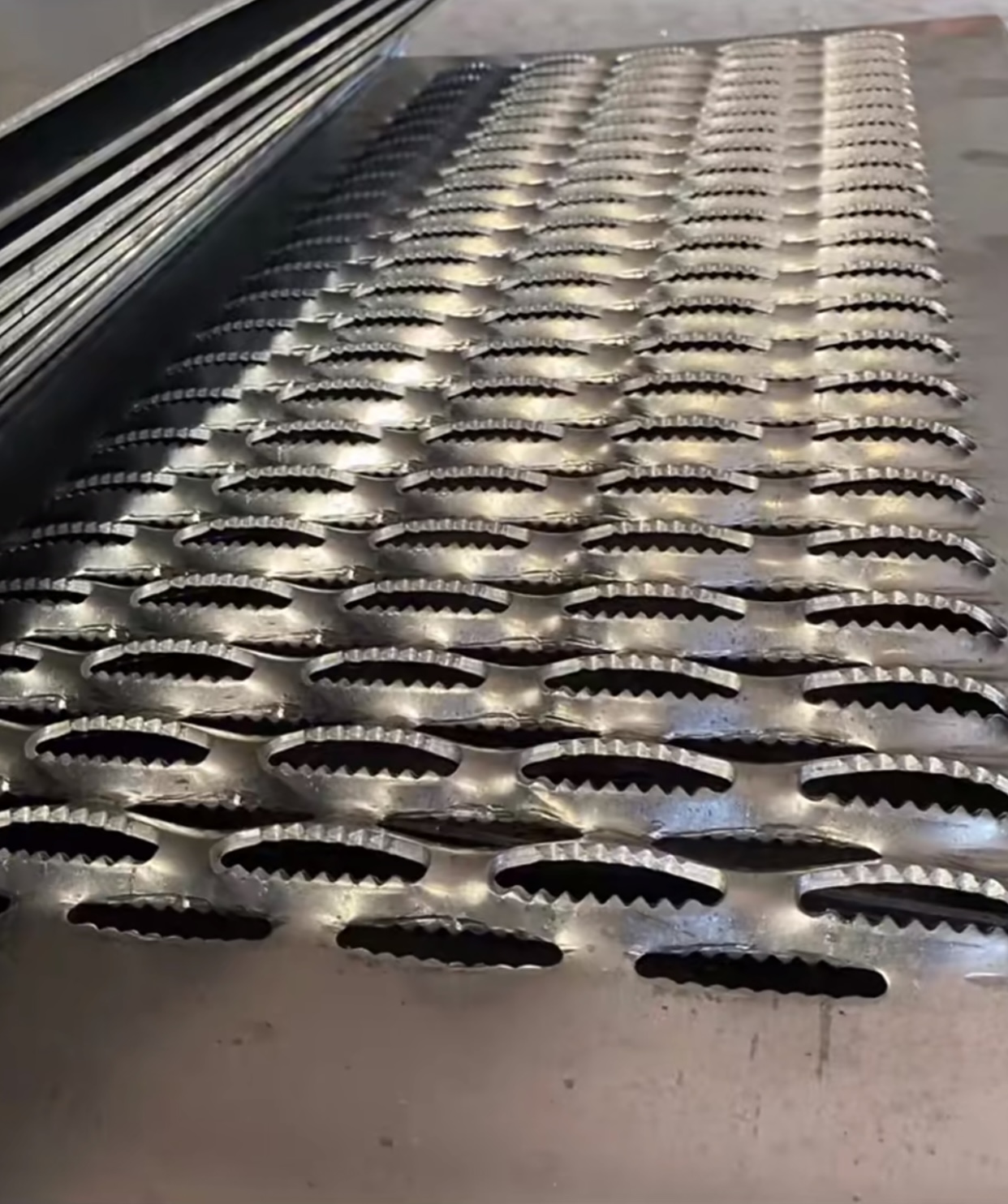
Anti-slip mechanism creates the core difference between these two metal flooring options. Standard checkered plate relies entirely on shallow embossed raised patterns to create surface friction. Once water, oil or mud covers the surface, its dynamic friction coefficient drops sharply. Crocodile mouth anti-slip plate adopts densely arranged serrated crocodile-tooth protrusions formed by integrated punching and bending. This multi-point serrated structure bites firmly into safety shoe soles, even when footwear is soaked with oil, water or slurry.
Checkered plate only works reliably for safety shoes with deep tread grooves. Flat-soled safety boots, rain boots and clean-room footwear lose traction easily on wet checker plate. Tribology testing for industrial walkway anti-slip performance follows ASTM F2508, the standard practice for calibration and validation of walkway tribometers. A peer-reviewed study published in Wear Journal confirms serrated open anti-slip structures retain stable friction coefficients under oily contamination, while continuous embossed textures rapidly lose grip once liquid film forms.
Drainage and self-cleaning capability separate these two flooring products clearly. Crocodile mouth anti-slip plate has open gaps between each raised tooth structure. Water, oil, cutting fluid, sand and metal debris fall through gaps quickly and never accumulate on the walking plane. Ordinary checkered plate maintains a nearly continuous solid surface. Liquids get trapped inside texture grooves and form water or oil film, greatly raising slip risk. ISO 14122-2 defines safety rules for industrial working platforms and walkways, and explicitly marks drainage design as a core safety factor for wet industrial platforms.
Wear resistance and effective service life show another obvious performance gap. The anti-slip teeth of crocodile mouth plate are layered in structure. Even after the top tooth edge wears down from long-term trampling, the lower serrated profile still retains anti-slip ability, so friction performance decays slowly and predictably. Once the shallow embossed patterns of checkered plate wear flat, its anti-slip function disappears almost instantly, turning it into a smooth plain metal sheet. Research published in the Journal of Constructional Steel Research notes open serrated anti-slip metal panels deliver far longer effective service life than embossed checkered plates under cyclic abrasive loading.
Bearing capacity and structural rigidity differ under identical raw plate thickness. Crocodile mouth anti-slip plate gains extra rigidity from punching and folded edge forming. Local concentrated loads from forklift wheels or heavy tool carts are less likely to trigger bending deformation. Checkered plate only relies on base plate thickness for load bearing, without folded reinforcing geometry, so it sags more easily under equal load conditions. ASTM A786/A786M sets specifications for hot-rolled carbon steel checkered plate, covering mechanical properties and dimensional tolerance of embossed patterns.
Cleaning and daily maintenance workload varies greatly between these two options. Crocodile mouth anti-slip plate supports direct water flushing; waste flows away through gaps automatically, with very low dirt accumulation risk. Debris, sludge and oil sediment easily lock inside the concave grooves of checkered plate. Operators must scrub repeatedly to clear contamination, raising maintenance frequency and labour cost year after year.
Unit price and comprehensive lifecycle cost deserve rational evaluation. The unit price of crocodile mouth anti-slip plate is roughly 15%–30% higher than standard checkered plate. But its longer usable life, fewer safety accidents, lower maintenance frequency and less frequent replacement reduce overall long-term operating expenditure. From the perspective of factory safety management and insurance risk control, it delivers better economic value across the whole service cycle. ASCE Journal of Structural Engineering has published research on lifecycle cost analysis for industrial metal flooring systems, supporting this economic comparison. Frontiers in Public Health publishes occupational slip risk research for cold and salt-contaminated floors.
Corrosion resistance is another critical factor often overlooked during procurement. Galvanized finishes offer basic rust protection for both plate types. However, checkered plate’s closed surface traps salt spray and chemical residue, speeding up rust formation. Crocodile mouth plate’s open design allows chemical spray, saltwater and moisture to drain away, slowing corrosion. For marine and chemical environments, 304 or 316 stainless steel grades are recommended.
3. Application Scenario Matching
✅ Dry indoor office passage, light pedestrian corridor, clean room walkway
Standard checkered plate is acceptable. The environment stays dry, with no oil or continuous water splash, and pedestrian flow remains light. It becomes a cost-effective selection for low safety-risk dry zones.
✅ Wet workshop, oil processing area, car wash platform, commercial kitchen walkway, marine deck, outdoor ramp
Crocodile mouth anti-slip plate is strongly recommended. Liquid accumulation is unavoidable in these scenes. The open drainage structure prevents water film and oil film formation, greatly lowering slip hazards for staff.
✅ Forklift passage, heavy-load industrial platform, equipment maintenance stand
Crocodile mouth anti-slip plate with thicker base material is the best choice. Its folded structure improves rigidity, resists wheel impact and local compression deformation, while retaining stable anti-slip teeth.
✅ Hidden support base, non-walk structural backing plate
Checkered plate or plain steel plate can be adopted. Anti-slip function is not required, and procurement cost control becomes the priority.
✅ Cold storage walkway, seafood processing plant
Stainless steel crocodile mouth anti-slip plate works best. Salt water and low temperature accelerate corrosion, and 304 or 316 stainless steel resists rust while maintaining reliable anti-slip performance. Research on slip prevention in occupational health, published by Frontiers in Public Health, highlights slip risks for cold and salt-contaminated industrial floors.
4. Engineering Design Points & Procurement Guidelines
Many buyers hold a widespread wrong assumption: textured metal plate automatically equals safe anti-slip flooring. In fact, anti-slip performance cannot be judged only by whether patterns exist on the surface. Continuous solid embossed textures fail quickly in wet and oily conditions, and this misunderstanding creates the most common selection mistake in industrial flooring procurement.
Material grade and surface treatment must match the service environment. Galvanized crocodile mouth plate suits ordinary workshops and outdoor platforms. 304 or 316 stainless steel versions are used for chemical plants, seafood processing workshops and marine decks with high corrosion risk. Aluminum crocodile mouth anti-slip plate is suitable for light-load, weight-sensitive projects such as temporary scaffolding walkways.
Specify serration height, base plate thickness and hole layout when issuing RFQ documents. Higher serration provides stronger grip, but overly sharp teeth may increase scratch risk for operators. Our factory can adjust tooth height, deburr sharp edges and fold safe border rims according to customer drawing requirements.
Support spacing design must match plate rigidity. Even high-quality crocodile mouth plate will deform if the support span is oversized. Our engineering team provides load calculation suggestions and support layout advice together with pre-production samples for client verification before mass manufacturing.
Finish sequencing also impacts long-term quality. Deburring and edge rounding should be completed before galvanizing or powder coating. If protective coating is applied over sharp raw serrations, the coating layer easily chips, and exposed sharp metal reappears quickly after installation and abrasion.
When writing purchase specifications, clearly define inspection criteria and acceptable friction coefficient targets, referencing ASTM and ISO standards. Vague descriptions such as “anti-slip plate” often lead to mismatched delivered products, site disputes and rework delays.
Installation details also affect final performance. Improper welding, uneven support or excessive gaps between panels can reduce overall rigidity and create tripping hazards. Our technical team can share standard installation drawings and construction reminders for installers.
5. Five Core Professional Takeaways
- Real Pain Point: Factories select low-cost checkered plate for oily or wet walkways. Oil and water gather inside texture grooves, patterns wear flat quickly, slip accidents happen frequently and safety risks keep rising.
- Counter-Intuitive Truth: The cheaper checkered plate with visible embossed patterns is not safer. Its anti-slip effect collapses once liquid covers the surface, while crocodile mouth plate still maintains reliable grip under wet-oil mixing conditions.
- Industry Professional Explanation: Checkered plate depends on shallow surface embossment for friction; crocodile mouth anti-slip plate uses punched folded serrated teeth to form multi-point occlusion, plus open gaps for instant drainage. This structural difference decides the gap in safety and durability.
- Conclusion: Standard checkered plate fits dry, light-duty pedestrian scenes. Crocodile mouth anti-slip plate is the preferred option for wet, oily, outdoor, forklift traffic and high safety requirement scenarios.
- Action Direction: Share your site environment, whether there is oil or water, pedestrian or forklift load, material requirement and size demand. We will recommend suitable plate thickness and serration specification, and provide friction and load reference data.
6. Factory Strength & Service Introduction
Jintong Perforated Metal Factory produces custom crocodile mouth anti-slip plates and checkered plates, supporting carbon steel, galvanized steel, stainless steel and aluminum materials. We control punching precision, serration forming, deburring, edge folding, galvanizing and cutting processing fully in-house. Our technical team combines tribology test data, site conditions and international safety standards to give targeted material selection suggestions, instead of simply following customer requests blindly.
We supply pre-production samples for friction testing, load inspection and on-site trial installation. Our global clients cover machinery workshops, aquaculture plants, shipyards, car wash chains, chemical factories and construction engineering contractors. Our team maintains rigorous process inspection, stable delivery cycle and clear after-sales communication. We focus on solving customer’s industrial safety flooring troubles with practical, durable metal anti-slip solutions. We can also customize panel size, serration direction, edge treatment and surface finish to fit unique project drawings.
📞 Tel/WhatsApp: +86 180 2733 7739
📧 Email: jtsw58@gmail.com
🌐 Website: perforatedmetalpanel.com
📸 Instagram: instagram.com/jintongperforatedmetal
💬 WhatsApp: shorturl.at/jdI6P
🔗 LinkedIn: Andy Liu
▶ YouTube: Jintong-n7d
🌐 Web WhatsApp: web.whatsapp.com
👍 Facebook: facebook.com/me
📱 Direct WhatsApp Chat: https://api.whatsapp.com/send?phone=8618027337739
This article helps workshop managers, mechanical engineers and procurement buyers distinguish crocodile mouth anti-slip plate and ordinary checkered plate, clarify friction, drainage, wear and load differences, avoid wrong material selection and reduce slip accident risks. Are you comparing anti-slip flooring for oily workshops, ship decks or forklift ramps and unsure which plate fits your project? Send your site condition and load requirement, we can give you a targeted anti-slip solution and quotation plan.
This content helps you solve the slip hazard problem of industrial walkways, cut accident losses and reduce long-term maintenance costs for workshop platforms, stair treads and marine decks.
#crocodilemouthantislipplate#gripstrutantiskidplate#checkeredplate#diamondcheckerplate#industrialantislipwalkway#stairtreadantislipplate#workshopantislipfloor#oilyfloorantislipsheet#marineantislipdeckplate#forkliftrampantislip#galvanizedcrocodilemouthplate#stainlesssteelantislipplate#aluminumantislipgrating#perforatedantislipsheet#wetfloorantislipsolution#antislipfrictioncoefficient#astmf2508antislip#iso14122platformsafety#industrialflooringprocurement#metalantislipgrating#Jintongperforatedmetal#customantislipplate#antislipplatefactory#antislipplatecomparison#safetywalkwaygrating#machineshopflooring#outdoorrampantislip#selfdrainingantislipplate#abrasionresistantantislipsheet#antislipplatformplate#constructionantislipmetal#shipdeckantislip#carwashfloorplate#antislipplateinstallation#heavydutyantislipgrating#checkeredplatewearproblem#antislipplatesample#metalflooringengineer#antislipretrofitsolution#industrialfallprevention