



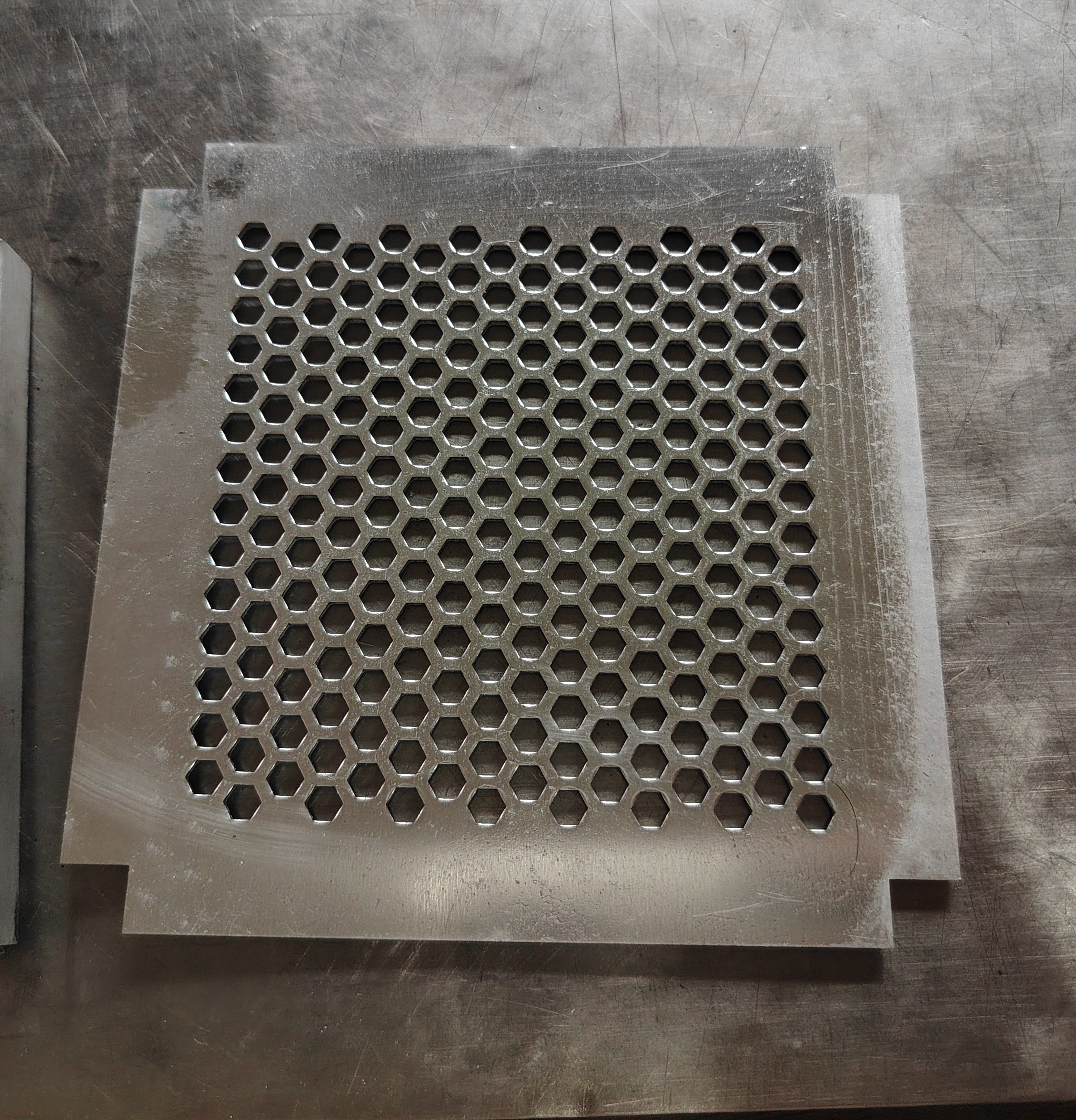
Features of Honeycomb Perforated Panels: Hexagonal Perforated Sheets VS Perforated Aluminum Honeycomb Composite Panels
Features of Honeycomb Perforated Panels: Hexagonal Perforated Sheets VS Perforated Aluminum Honeycomb Composite Panels
Overview
Honeycomb perforated panels represent two distinct metal products frequently mixed up by specifiers: single-sheet hexagonal perforated panels and sandwich-style perforated aluminum honeycomb composite panels. One acoustic contractor once misselected standard single hexagonal punched sheets for an auditorium ceiling. After installation, the panels sagged over wide spans and failed reverberation testing due to the lack of resonant cavities. Our factory clarified the structural difference, switched to perforated aluminum honeycomb composite panels, produced pre-production samples and tuned the honeycomb core depth to hit acoustic targets. This guide covers application scenarios, specification parameters, design considerations, industry standards and real engineering cases. You can combine Acoustic Perforated Panels, Decorative Perforated Panels and Anti-Slip Perforated Panels for integrated building enclosure solutions.
1. Application Scenarios
Hexagonal perforated sheets, commonly called honeycomb perforated panels, serve cost-focused ventilation, mechanical guarding and facade decoration projects. When plant rooms need ventilation plus noise reduction, designers often pair hexagonal perforated layouts with Acoustic Perforated Panels. Research from the Acoustical Society of America confirms regular hexagonal hole arrays deliver more uniform airflow distribution than irregular or round-hole layouts.
For maintenance walkways adjacent to perforated facades, engineers specify Anti-Slip Perforated Panels to satisfy workplace slip-resistance codes. Architectural Digest regularly features Decorative Perforated Panels matched with honeycomb composite cladding for premium auto showroom facades and commercial lobbies.
Perforated aluminum honeycomb composite panels are built for high-end large-area architecture, including concert hall ceilings, airport facades and long-span curtain walls. Many buyers mistakenly choose single hexagonal sheets for oversized ceiling schemes, which causes deflection, sagging and poor acoustic outcomes. The Journal of Sandwich Structures & Materials quantifies stiffness gaps between solid perforated sheets and bonded honeycomb sandwich assemblies.
2. Specification Parameters & Core Features
Hexagonal Perforated Panels (Single Punched Sheet)
This variant is a solid metal plate CNC-stamped with continuous regular hexagonal holes, the standard honeycomb perforated sheet we manufacture daily. The hexagonal lattice distributes forming stress evenly. At identical open area, it delivers higher rigidity and better crack resistance than round-hole perforated panels. Usual open area ranges 40%–70%, supporting strong ventilation, heat dissipation and daylight penetration for air conditioner guards, exterior decorative walls and equipment protective covers.
Interlocking hexagonal edges form a self-supporting lattice structure, improving bending resistance and impact performance versus equal-thickness round-hole sheets. CNC punching supports custom hole size, across-flat dimension and pitch. Available substrates are aluminum, galvanized steel and stainless steel, with fluorocarbon or powder coating for outdoor exposure.
Its geometric honeycomb texture creates a clean, minimalist aesthetic widely adopted for 4S store facades, room dividers and suspended ceilings. The primary weakness is sharp hole corners requiring deburring. Punching holes too close to panel edges raises cracking risk during stamping. Wind load design for these single sheets follows ASCE Engineering ASCE 7-22.
Perforated Aluminum Honeycomb Composite Panels (Sandwich Large Panel)
This composite panel is not stamped from a single sheet. It consists of a perforated face skin, aluminum honeycomb core and rear backing plate bonded under high temperature and pressure. It combines ultra-low weight with exceptional rigidity. Large-format panels maintain excellent flatness and resist deformation, making it ideal for uninterrupted curtain walls and wide ceilings.
The perforated skin paired with enclosed honeycomb cells creates resonant cavities that deliver reliable sound absorption. It is widely used in concert halls, conference rooms and gymnasiums. It achieves Class A fire resistance, moisture stability and excellent weathering; fluorocarbon coating preserves color for decades, though its unit price is higher than single hexagonal perforated sheets. Finished large panels can be cut and bent on-site and are mostly installed via dry-hanging facade systems. ASTM International ASTM C393 defines flexural testing methods for these sandwich panels.
Quick Selection Guide for Clients
Choose hexagonal perforated panels (single punched sheet): air conditioner covers, safety railings, mechanical guards and budget decorative cladding.
Choose perforated aluminum honeycomb composite panels: large exterior curtain walls, long-span ceilings, acoustic engineering and projects requiring superior flatness.
ISO 12572 sets standardized sound absorption test protocols for cavity-type acoustic panels. The MDPI Journal of Composites Science publishes peer-reviewed studies on perforated honeycomb airflow and acoustic response.
3. Design Key Points
The core design rule separates structural, decorative and acoustic performance targets. Do not substitute single hexagonal perforated sheets for honeycomb composite panels only because they share the “honeycomb perforated” common name. Single hexagonal sheets fit small and medium ventilation components where low cost and airflow are priorities. Designers must reserve adequate edge margin and schedule deburring to eliminate sharp burr hazards. Aluminum’s ductility makes it more suitable than galvanized steel for dense hexagonal punching.
Specify perforated honeycomb composite panels when flatness, span length and acoustic control are critical. Engineers need to confirm core thickness, skin gauge and adhesive quality before production. The journal Thin-Walled Structures has published research on residual stress and bonding stability of metal sandwich panels exposed to temperature cycling.
Surface finishing must match the service environment. Powder coating suits inland decorative jobs, while coastal honeycomb composite panels require fluorocarbon coating for salt-spray resistance. Over-specifying composite panels for simple protective enclosures unnecessarily inflates project budgets. The National Association of Architectural Metal Manufacturers (NAAMM) publishes fabrication tolerance guides for architectural perforated metal and sandwich cladding.
4. Industry Standards
Multiple international standards govern these two honeycomb perforated panel categories separately. ASTM B209 covers aluminum sheets for single hexagonal punching. ASTM A653 sets requirements for hot-dip galvanized perforated substrates. ASTM C273 tests shear strength, while ASTM C393 evaluates bending performance of aluminum honeycomb sandwich panels.
ISO 10630 defines dimensional tolerances for industrial perforated metal sheets. ISO 11654 specifies acoustic absorption classification for building acoustic panels. The MDPI Applied Sciences Journal shares simulation analysis of airflow and sound absorption through perforated honeycomb sandwich structures. ASTM E84 is widely referenced for surface burning characteristics for facade and ceiling assemblies.
Project acceptance checklists should distinguish cosmetic visual tolerances for decorative hexagonal perforated sheets from structural, fire and acoustic performance requirements for outdoor rainproof and acoustic honeycomb composite panels. This separation prevents costly handover disputes between fabricators and contractors.
5. Case Analysis & Core Takeaways with Interactive Hook
One acoustic engineering customer sourced ceiling panels for a multi-purpose auditorium. They initially ordered standard single hexagonal perforated sheets, assuming all “honeycomb perforated” panels deliver strong sound absorption. After sample mounting, reverberation time failed acoustic acceptance, and 2.4m wide sheets sagged visibly without dense subframing.
Our technical team explained that single hexagonal panels only have surface holes, without enclosed resonant cavities. We recommended perforated aluminum honeycomb composite panels, produced acoustic pre-production samples, adjusted honeycomb core depth and optimized dry hanging anchor points. The revised ceiling met all acoustic indexes and kept perfect flatness across the entire hall.
A second client purchased hexagonal perforated panels for a batch of air conditioner outer unit guards. They removed deburring from the scope to cut cost, leading to complaints of sharp burrs scratching installation workers. We added automatic rotary deburring and sanding steps for their next order, staying within their target unit price while removing safety risks.
These two cases highlight four frequent engineering mistakes: confusing hexagonal punched sheets with honeycomb composite panels, misunderstanding acoustic resonant principles, ignoring deburring safety requirements, and applying thin single sheets for large-span flat surfaces. Our factory fabricates both product lines. We provide sample testing, acoustic simulation, stamping risk assessment and custom coating solutions. We maintain a full inventory of standard hexagonal punching moulds and support custom honeycomb composite panel sizes.
Here are the five core elements:
- Real Pain Point: Buyers confuse hexagonal single-sheet perforated panels with perforated aluminum honeycomb composite panels because of the shared “honeycomb perforated” nickname, leading to failed acoustic tests, panel sagging or overspending.
- Counterintuitive Fact: Not all honeycomb-named perforated panels include acoustic cavity structures. Single hexagonal punched sheets cannot match the sound absorption and large-span flatness of composite honeycomb panels.
- Industry Expert Explanation: Hexagonal perforated panels are one-layer stamped metal built for ventilation and decoration. Perforated aluminum honeycomb composite panels are three-layer sandwich assemblies with resonant cavities, delivering superior flatness and acoustic performance at a higher cost.
- Conclusion: Select hexagonal perforated sheets for small guards, ventilation covers and budget decoration; select perforated aluminum honeycomb composite panels for large curtain walls, long ceilings and professional acoustic projects.
- Action Direction: Send us your panel size, acoustic requirement, budget and installation layout, and our engineering team will recommend the correct honeycomb perforated panel type and provide free sample evaluation.
If you are sourcing honeycomb perforated panels for HVAC guards, partition decoration, auditorium acoustic ceilings or facade cladding, share your panel span limit, noise target and budget range. Our team can select the proper product type, arrange pre-production samples and provide factory-direct pricing.
This article helps you avoid product mix-ups, acoustic failure, panel deflection and unnecessary extra costs for honeycomb perforated panels, enabling accurate specification selection and fewer project reworks.
📞 Tel/WhatsApp: +86 180 2733 7739
📧 Email: jtsw58@gmail.com
🌐 Website: https://perforatedmetalpanel.com
📸 Instagram: https://instagram.com/jintongperforatedmetal
💬 WhatsApp: https://shorturl.at/jdI6P
🔗 LinkedIn: https://linkedin.com/in/andy-liu-36a033355
▶ YouTube: https://youtube.com/@Jintong-n7d
🌐 Facebook: https://facebook.com/me
WhatsApp Direct Link: https://api.whatsapp.com/send?phone=8618027337739
#honeycombperforatedpanel#hexagonalperforatedsheet#perforatedaluminumhoneycombpanel#singlepunchedhoneycombsheet#aluminumhoneycombcompositepanel#honeycombventilationpanel#honeycombacousticpanel#hexagonholeperforatedmetal#galvanizedhexagonalperforatedpanel#stainlesssteelhoneycombperforatedsheet#airconditionerhoneycombguard#showroomfacadeperforatedpanel#auditoriumacousticceiling#honeycombcurtainwallpanel#metalpartitionperforatedsheet#cncpunchedhexagonalpanel#honeycombpaneldeburring#honeycombsandwichpanel#lightweightperforatedcladding#jintongperforatedmetal#honeycombpanelfactory#customhexagonalperforatedsheet#openarea40-70percent#soundabsorptionhoneycombpanel#fluorocarboncoatedhoneycombpanel#dryhanginghoneycombcladding#hvacprotectiveperforatedcover#gymnasiumacousticpanel#4Sshowroomdecorativepanel#honeycombperforatedsheetfabrication#bendingresistantperforatedsheet#impactproofhexagonalpanel#large-spanhoneycombceiling#honeycombperforatedsample#weatherresistanthoneycombpanel#acousticcavitypanel#hexagonperforateddivider#honeycombmetalventcover#sandwichhoneycombperforatedpanel#honeycombperforatedspecguide